# Junovy Cloud Storage
**Complete guide to using Junovy Cloud Storage for file management, collaboration, and productivity**
This tutorial walks you through everything you need to know to maximize your Junovy Cloud Storage experience. From initial setup and file organization to advanced collaboration features and security settings, you'll learn to leverage NextCloud's full capabilities for your business or personal needs.
**What You'll Learn:**
- Account setup and desktop/mobile app installation
- File uploading, organizing, and sharing workflows
- Team collaboration tools (shared folders, comments, real-time editing)
- Calendar and contact management integration
- Security features (two-factor auth, encryption, access controls)
- Mobile access and offline sync configuration
- Backup and version history management
# Account Setup
**Get started with your Junovy Cloud Storage account and complete initial login configuration**
This chapter guides you through the essential first steps to access your Junovy Cloud Storage service. You'll learn how to use your provided credentials to log in through our authentication portal and configure your account for optimal security and usability.
**Chapter Contents:**
- Using your provided username and login credentials
- Accessing the Junovy authentication portal at [https://auth.junovy.com](https://auth.junovy.com)
- Completing your first login and password setup
- Enabling two-factor authentication (recommended)
- Updating account profile and contact information
- Understanding your storage quota and plan limits
- Troubleshooting common login issues
**Prerequisites:** Valid Junovy Cloud Storage account credentials provided by your administrator or signup confirmation.
# Getting Started
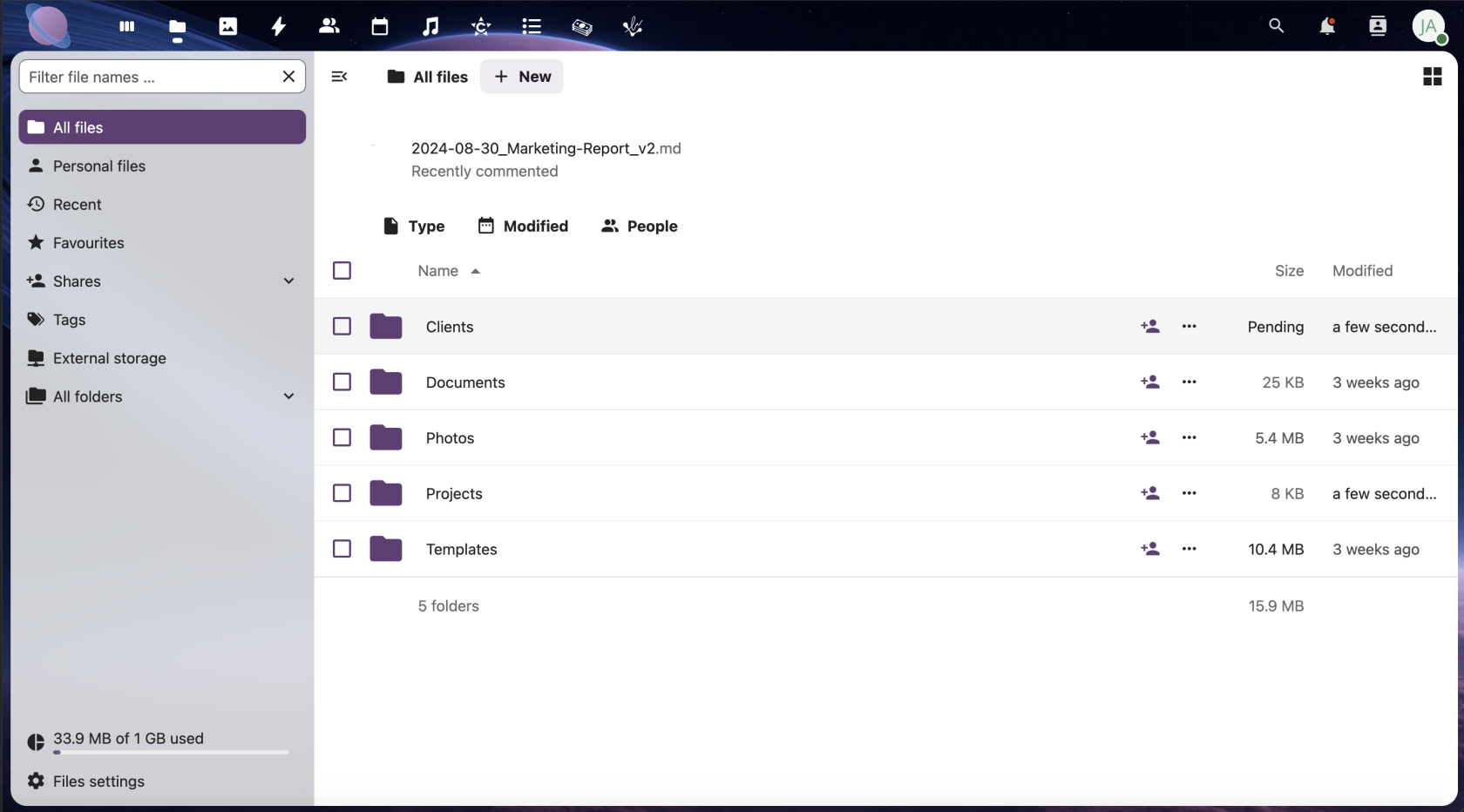
Welcome to Junovy Cloud Storage! This page will walk you through your first login and initial setup. Junovy Cloud Storage is available with a Business subscription and higher.
[](https://cdn.eu-west-1.junovy.com/bookstack/uploads/images/gallery/2025-09/image.png)
### Step 1: Prepare Your Login Information
Before you begin, make sure you have:
- The email you used to signup for Junovy services.
- Your temporary password (sent via email or provided by support)
- Access to your email for account verification
### Step 2: Access the Login Portal
1. Open your web browser and go to **[https://cloud.junovy.com](https://cloud.junovy.com)**
2. If you are not currently logged in, you'll see the Junovy authentication page
### Step 3: Enter Your Credentials
1. Enter your **username** in the first field
2. Enter your **password** in the second field
3. Click the **Sign In** button
### Step 4: Set Up a Secure Password
If this is your first login, you'll be prompted to change your password:
1. Create a strong password with **more than 12 characters**
2. Include a mix of uppercase letters, lowercase letters, numbers, and symbols
3. **Tip:** Consider using a password manager like Bitwarden, 1Password, or your browser's built-in password manager to generate and store secure passwords
4. Confirm your new password
5. Click **Update Password**
### Step 5: Access Your Cloud Storage
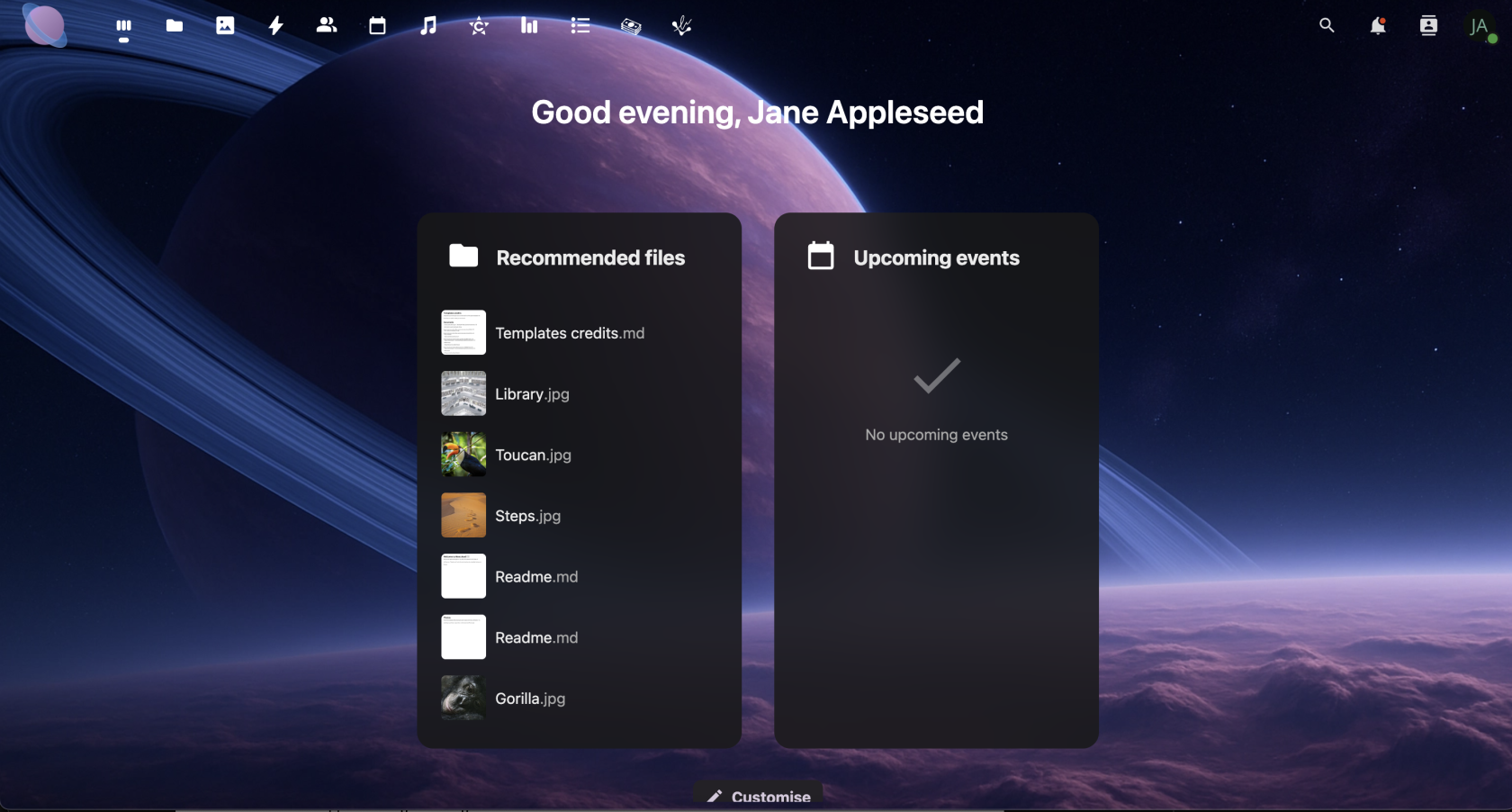
After successful login, you'll be automatically redirected to your cloud storage dashboard at **[https://cloud.junovy.com/apps/dashboard/](https://cloud.junovy.com/apps/dashboard/)**
[](https://cdn.eu-west-1.junovy.com/bookstack/uploads/images/gallery/2025-08/6Krimage.png)
### Step 6: Enable Two-Factor Authentication (Recommended)
For enhanced security, set up two-factor authentication:
1. Go back to **[https://auth.junovy.com/realms/dds/account](https://auth.junovy.com/realms/dds/account)**
2. Navigate to your **Junovy User Profile**
3. Look for the **Two-Factor Authentication** or **Security** section
4. Follow the setup instructions to add your authenticator app
### Next Steps
Congratulations! Your Junovy Cloud Storage account is now ready to use. In the next chapter, you'll learn how to install the desktop and mobile apps for seamless file synchronization.
## Troubleshooting
- **Can't remember your username?** Contact your administrator or Junovy support.
- **Password not working?** Try the password reset option on the login page or contact support.
- **Not redirected to cloud storage?** Check your browser settings and ensure JavaScript is enabled.
# Mobile and Desktop Apps
Stay connected to your files wherever you are with Junovy Cloud Storage's mobile and desktop applications. These apps provide seamless synchronization, offline access, and automatic backup capabilities.
### Available Applications
**Desktop Apps:**
- Windows (Windows 10/11)
- macOS (macOS 10.14+)
- Linux (Ubuntu, Fedora, openSUSE)
**Mobile Apps:**
- iOS (iPhone/iPad)
- Android
### Step 1: Download Desktop App
#### For Windows:
1. Go to your Junovy Cloud Storage dashboard at **https://cloud.junovy.com**
2. Click on your **profile icon** in the top-right corner
3. Select **Apps** or **Download** from the dropdown menu
4. Click **Download for Windows**
5. Run the downloaded `.exe` file and follow the installation wizard
*\[Screenshot: Download page showing Windows download button\]*
#### For macOS:
1. From the same download page, click **Download for Mac**
2. Open the downloaded `.dmg` file
3. Drag the Junovy app to your Applications folder
4. Launch from Applications or Launchpad
*\[Screenshot: macOS installation showing drag-to-Applications\]*
#### For Linux:
1. Click **Download for Linux** and select your distribution
2. Install using your package manager or follow the provided instructions
3. Launch from your applications menu
### Step 2: Configure Desktop App
1. **Launch** the Junovy desktop app
2. Enter your server address: **https://cloud.junovy.com**
3. Click **Next**
4. You'll be redirected to the login page - enter your credentials
5. **Grant access** when prompted
6. Choose which folders to sync locally (or sync everything)
7. Select your local sync folder location
8. Click **Connect**
### Step 3: Download Mobile Apps
#### For iOS (iPhone/iPad):
1. Open the **App Store**
2. Search for **"Nextcloud"**
3. Download and install the official Nextcloud app
4. Open the app and tap **Log in**
5. Enter server address: **https://cloud.junovy.com**
6. Complete authentication through the browser popup
#### For Android:
1. Open **Google Play Store**
2. Search for **"Nextcloud"**
3. Install the official Nextcloud app
4. Open and tap **Log in**
5. Enter server address: **https://cloud.junovy.com**
6. Authenticate when redirected to your browser
*\[Screenshot: Android Play Store showing Nextcloud app\]*
### Step 4: Configure Mobile Sync Options
After logging in to your mobile app:
1. Tap the **hamburger menu** (three lines) in the top-left
2. Go to **Settings**
3. Configure these recommended options:
- **Auto Upload Photos**: Enable to automatically backup your photos
- **Auto Upload Videos**: Enable for video backup
- **Upload via WiFi only**: Recommended to save mobile data
- **Instant Upload folder**: Choose where uploads go (usually "InstantUpload")
*\[Screenshot: Mobile app settings showing auto-upload options\]*
### Step 5: Test Your Setup
1. **Create a test file** on one device (desktop, mobile, or web)
2. **Check synchronization** across all your devices
3. **Verify offline access** by going offline and opening a synced file
4. **Test photo upload** by taking a picture (if auto-upload is enabled)
### Managing Storage and Sync
**Desktop Sync Options:**
- Right-click the Junovy icon in your system tray/menu bar
- Choose **Settings** to modify sync folders
- Use **Selective Sync** to save local storage space
**Mobile Storage Management:**
- Only files you explicitly download are stored locally
- Starred files can be made available offline
- Clear app cache in settings if storage gets low
### Troubleshooting
**Desktop app won't connect?** Check your internet connection and ensure https://cloud.junovy.com is accessible.
**Mobile app crashes?** Try logging out and back in, or reinstall the app.
**Files not syncing?** Check that you have sufficient storage space on your device and stable internet connection.
**Two-factor authentication issues?** Make sure you're using an app password if required, or disable 2FA temporarily during setup.
# Organizing Files
**Master file and folder organization to keep your Junovy Cloud Storage tidy, searchable, and efficient for team collaboration**
This chapter teaches you essential file management skills to maintain an organized cloud storage system. You'll learn folder structure best practices, file naming conventions, and how to use tags and favorites to quickly locate your content as your storage grows.
**Chapter Contents:**
- Creating and managing folder hierarchies
- File naming conventions for easy searching
- Using tags, comments, and metadata
- Organizing shared folders for team collaboration
- Setting up favorites and quick access shortcuts
- Bulk file operations (move, copy, rename)
- Archive and cleanup strategies for old files
- Search techniques and saved search filters
**Skills You'll Gain:**
- Design logical folder structures that scale with your needs
- Implement consistent naming systems across your organization
- Use NextCloud's organizational features effectively
- Maintain clean, searchable file systems over time
**Prerequisites:** Completed account setup and have desktop/mobile apps installed.
# Creating Folder Structures
A well-organized folder structure is the foundation of efficient file management. This page will help you design a logical hierarchy that grows with your needs and makes finding files effortless.
### Why Good Organization Matters
- **Save time** searching for files
- **Improve collaboration** when sharing with team members
- **Reduce confusion** about file versions and locations
- **Scale efficiently** as your storage grows
- **Maintain consistency** across projects and users
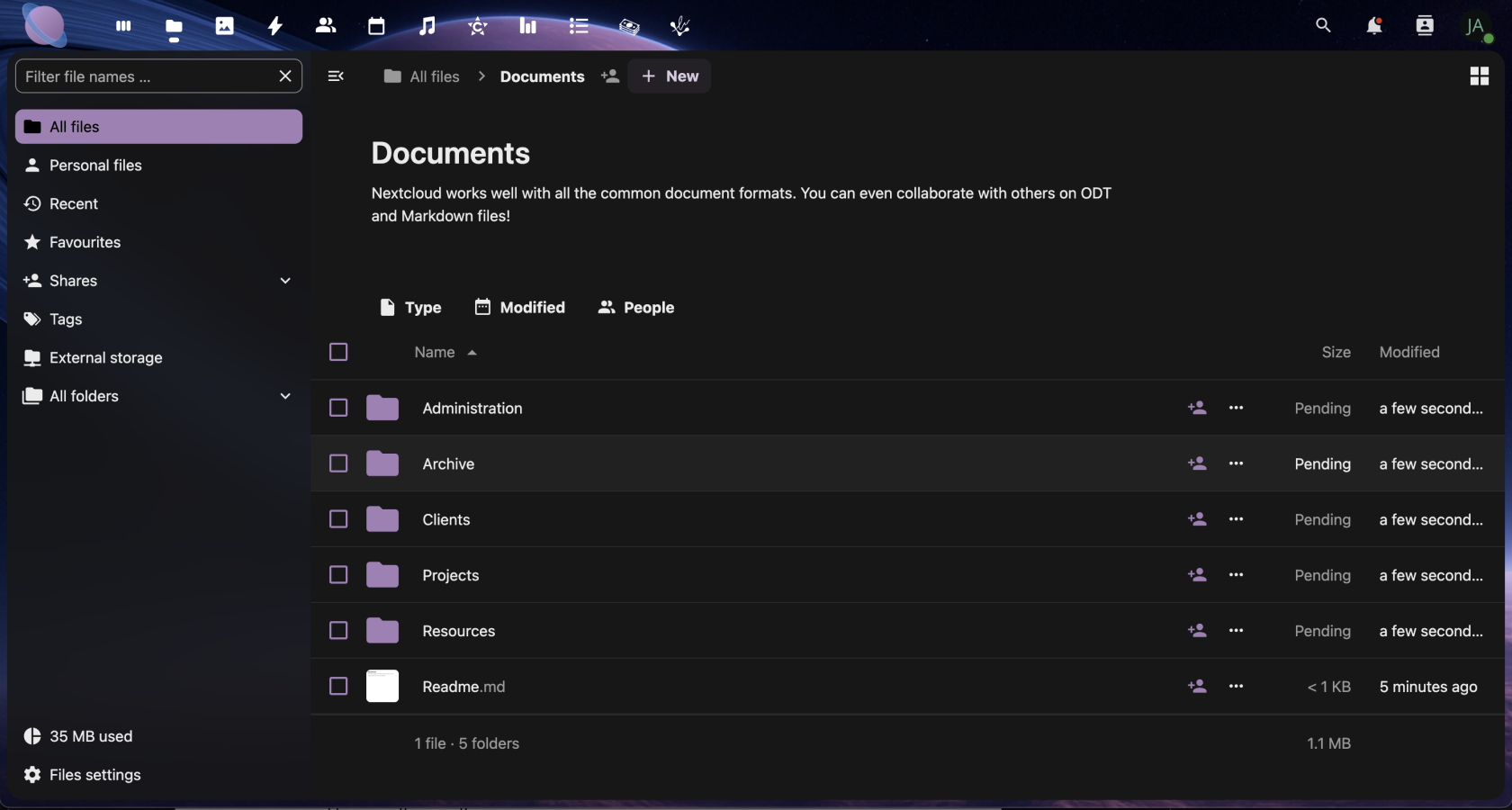
### Step 1: Plan Your Main Categories
Before creating folders, think about how you naturally group your work:
**For Business Users:**
- Projects
- Clients
- Administration
- Resources/Templates
- Archive
**For Personal Users:**
- Documents
- Photos
- Work
- Personal
- Backup
[](https://cdn.eu-west-1.junovy.com/bookstack/uploads/images/gallery/2025-08/s0iimage.png)
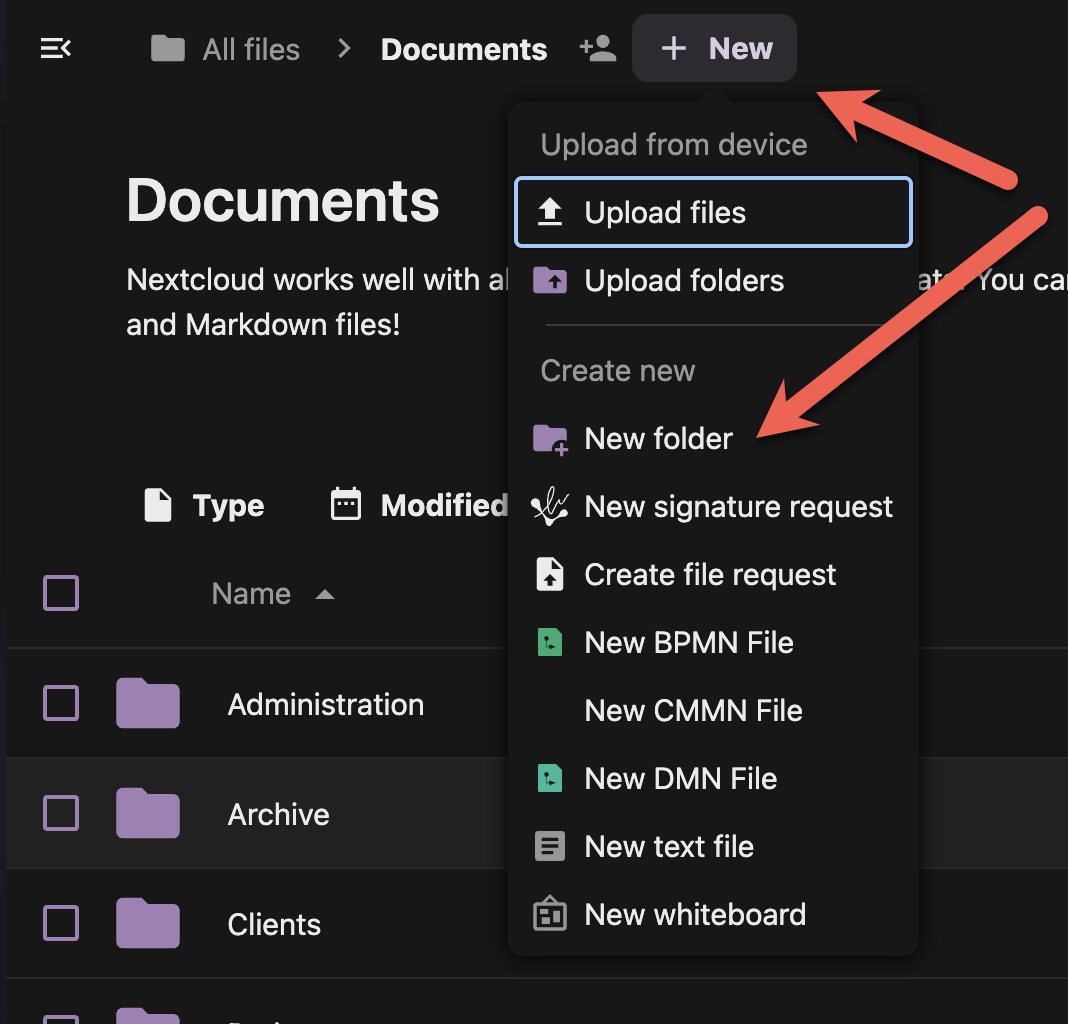
### Step 2: Create Your Top-Level Folders
1. **Navigate** to your Junovy Cloud Storage at https://cloud.junovy.com
2. Click the **"+" (New)** button in the main files view
3. Select **"New Folder"**
4. Enter your folder name (e.g., "01 - Projects")
5. Press **Enter** to create
6. Repeat for all main categories
[](https://cdn.eu-west-1.junovy.com/bookstack/uploads/images/gallery/2025-08/QFpimage.png)
**Pro Tip:** Use numbers to control folder order (01, 02, 03) since folders sort alphabetically.
### Step 3: Build Subfolders with Purpose
Create 2-3 levels maximum to avoid deep nesting:
**Example: Projects Structure**
```
01 - Projects/
├── 2024-Website-Redesign/
│ ├── Assets/
│ ├── Documents/
│ └── Final-Deliverables/
├── 2024-Marketing-Campaign/
│ ├── Creative/
│ ├── Reports/
│ └── Resources/
└── Templates/
```
1. **Double-click** a main folder to open it
2. Use the **"+" button** to create subfolders
3. Keep subfolder names **descriptive but concise**
4. Maintain **consistent naming** across similar projects
### Step 4: Implement Naming Conventions
**Date-Based Naming:**
- Use YYYY-MM-DD format for chronological sorting
- Example: "2024-08-30-Meeting-Notes"
**Project-Based Naming:**
- Start with project code or client name
- Example: "ACME-Logo-Design-v3"
**Status Indicators:**
- Add prefixes for file status
- Examples: "DRAFT-", "FINAL-", "REVIEW-"
### Step 5: Set Up Standard Subfolders
Create consistent subfolders within projects:
**Recommended Subfolders:**
- **Assets** - Images, logos, resources
- **Documents** - Text files, PDFs, presentations
- **Working** - Draft files and work-in-progress
- **Final** - Completed deliverables
- **Archive** - Old versions and unused files
1. Select multiple folders by **holding Ctrl** (Windows/Linux) or **Cmd** (Mac)
2. Right-click and choose **"Create subfolder structure"** if available
3. Or create subfolders manually in each project
### Step 6: Use Color Coding (Optional)
Add visual organization with folder colors:
1. **Right-click** any folder
2. Select **"Details"** or **"Properties"**
3. Choose a **color tag** from the available options
4. Use consistent colors for similar folder types
*\[Screenshot: Folder color options in the right-click menu\]*
**Color Coding Examples:**
- 🔴 Red: Urgent/Important
- 🟡 Yellow: In Progress
- 🟢 Green: Completed
- 🔵 Blue: Client Work
- 🟣 Purple: Personal
### Best Practices Summary
✅ **Do:**
- Keep folder names under 50 characters
- Use consistent naming conventions
- Limit hierarchy to 3-4 levels maximum
- Plan your structure before creating folders
- Review and reorganize quarterly
❌ **Don't:**
- Use special characters in folder names
- Create folders for single files
- Duplicate folder structures
- Make folders too specific (they become empty)
- Ignore naming conventions once established
### Next Steps
With your folder structure in place, you're ready to learn about file naming conventions and tagging systems in the next page. A good folder structure combined with smart file naming makes your cloud storage incredibly efficient to navigate.
# File Naming Conventions
Consistent file naming is just as important as good folder structure. Smart naming conventions make files instantly recognizable, searchable, and easy to sort, whether you're working alone or with a team.
### Why File Naming Matters
- **Instant recognition** of file content and purpose
- **Chronological sorting** shows newest/oldest files first
- **Version control** prevents confusion about which file is current
- **Search efficiency** helps you find files using keywords
- **Team collaboration** ensures everyone understands file purposes
### Step 1: Choose Your Naming Format
Pick one format and stick to it across your entire organization:
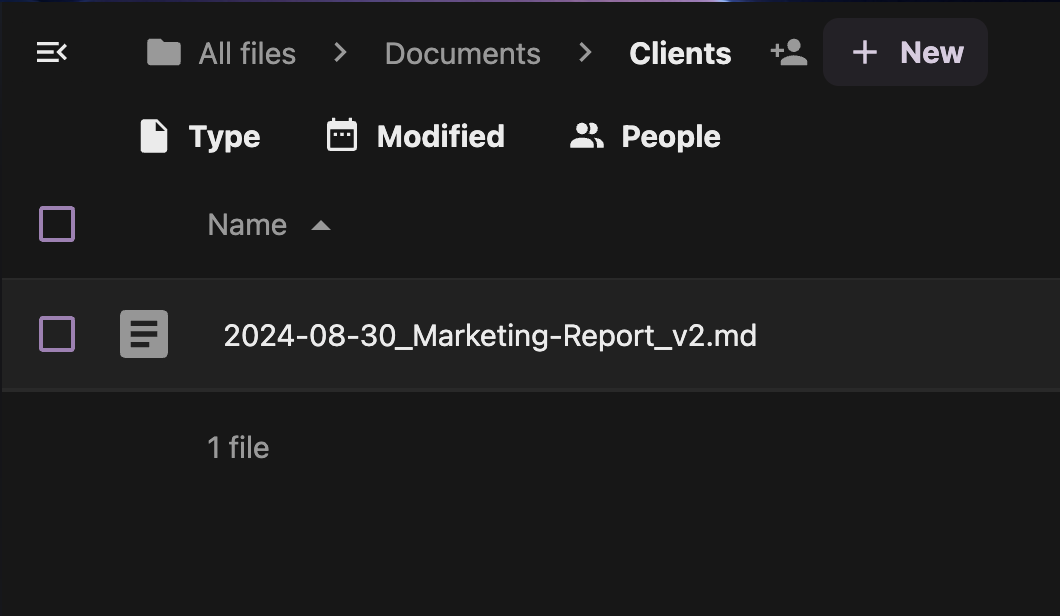
**Date-First Format (Recommended):** `YYYY-MM-DD_Description_Version`
- Example: `2024-08-30_Marketing-Report_v2.pdf`
- **Benefit:** Automatic chronological sorting
**Project-First Format:** `ProjectCode_Description_YYYY-MM-DD`
- Example: `ACME_Logo-Design_2024-08-30.ai`
- **Benefit:** Groups project files together
**Client-First Format:** `ClientName_ProjectType_Description`
- Example: `Johnson-Co_Website_Homepage-Mockup.psd`
- **Benefit:** Easy client file identification
[](https://cdn.eu-west-1.junovy.com/bookstack/uploads/images/gallery/2025-08/QKDimage.png)
### Step 2: Create a Naming Template
Document your chosen format for team consistency:
**Template Example:**
```
Format: [Date]_[Project]_[Description]_[Version]
Date: YYYY-MM-DD
Project: Short code or client name
Description: What the file contains
Version: v1, v2, final, draft
```
1. **Create a new document** in your Templates folder
2. **Title it:** "File Naming Convention"
3. **Include examples** for different file types
4. **Share with team members** for consistency
## Step 3: Handle Different File Types
**Documents:**
- `2024-08-30_Proposal_ClientName_v3.docx`
- `2024-08-30_Invoice_12345_final.pdf`
- `2024-08-30_Meeting-Notes_TeamSync.txt`
**Design Files:**
- `2024-08-30_Logo_ACME_concept-A.ai`
- `2024-08-30_Banner_Homepage_1920x1080.png`
- `2024-08-30_Mockup_Mobile-App_wireframe.sketch`
**Media Files:**
- `2024-08-30_Video_Product-Demo_4K.mp4`
- `2024-08-30_Photo_Team-Headshots_processed.jpg`
- `2024-08-30_Audio_Podcast_Episode-15.wav`
## Step 4: Implement Version Control
Use clear version indicators to track file evolution:
**Version Naming Options:**
- **v1, v2, v3** - Simple numeric versions
- **draft, review, final** - Status-based naming
- **YYYY-MM-DD** - Date-based versions
- **initials** - Author-based versions (JD, SM, etc.)
**Example Version Progression:**
```
2024-08-30_Website-Proposal_ACME_draft.docx
2024-08-30_Website-Proposal_ACME_v2.docx
2024-08-30_Website-Proposal_ACME_review.docx
2024-08-30_Website-Proposal_ACME_final.docx
```
## Step 5: Rename Existing Files
Clean up your current files to match your new convention:
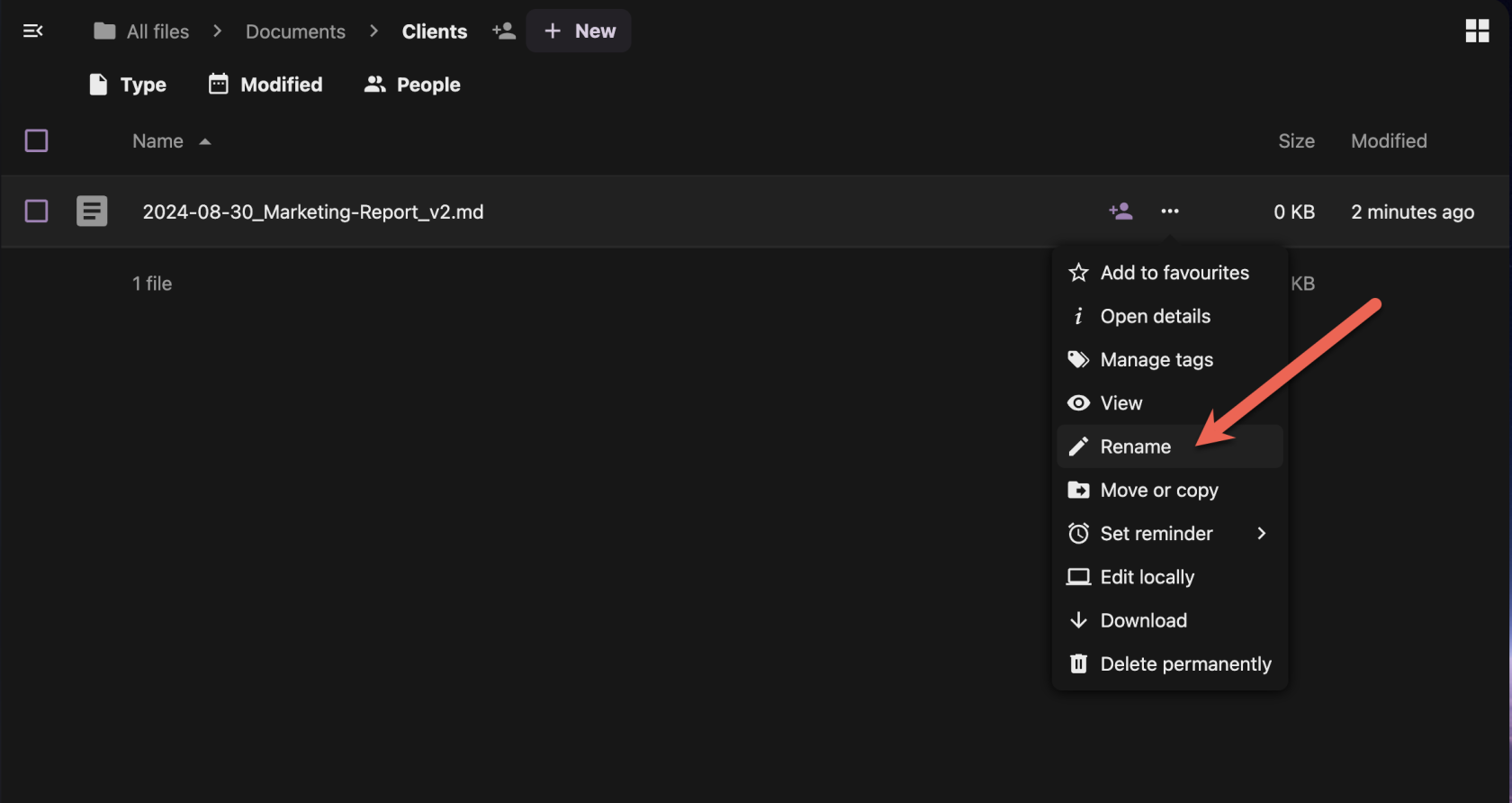
1. **Right-click** a file you want to rename
2. Select **"Rename"** from the context menu
3. **Update the filename** following your convention
4. Press **Enter** to save
**Bulk Renaming (Advanced):**
- Select multiple similar files using **Ctrl+click**
- Use the desktop app's bulk rename feature if available
- Consider renaming in batches by file type or project
[](https://cdn.eu-west-1.junovy.com/bookstack/uploads/images/gallery/2025-08/Bqtimage.png)
## Step 6: Use Descriptive Keywords
Include searchable keywords in your filenames:
**Good Examples:**
- `2024-08-30_SEO-Audit_Keywords-Research_final.xlsx`
- `2024-08-30_Brand-Guide_Logo-Colors-Fonts.pdf`
- `2024-08-30_Budget-Forecast_Q4-Planning.docx`
**Keywords to Include:**
- **Purpose:** audit, report, guide, template
- **Content type:** data, analysis, mockup, screenshot
- **Status:** draft, final, approved, archived
- **Audience:** internal, client, public, team
## Step 7: Avoid Common Naming Mistakes
❌ **Characters to Avoid:**
- Special characters: `/ \ : * ? " < > |`
- Spaces at beginning or end
- Multiple consecutive spaces
- Only numbers or dates
❌ **Bad Examples:**
- `untitled1.docx` (no description)
- `Final version 2 REAL final.pdf` (confusing versions)
- `client stuff/meeting notes.txt` (contains slash)
- `Document1 copy.docx` (generic name)
✅ **Good Examples:**
- `2024-08-30_Client-Presentation_Q3-Results_final.pptx`
- `2024-08-30_User-Research_Survey-Analysis_v2.xlsx`
- `2024-08-30_Contract_Service-Agreement_signed.pdf`
## Creating File Naming Templates
Set up templates for common file types:
1. **Navigate** to your Templates folder
2. **Create** example files with proper naming
3. **Use as reference** when creating new files
4. **Update templates** as your conventions evolve
**Template Examples:**
```
YYYY-MM-DD_Meeting-Notes_[Meeting-Type]_[Attendees].docx
YYYY-MM-DD_Invoice_[Client]_[InvoiceNumber].pdf
YYYY-MM-DD_Design_[Project]_[Version].[ext]
```
## Best Practices Checklist
✅ **Consistency Rules:**
- Use the same format across all files
- Stick to your chosen date format (YYYY-MM-DD recommended)
- Apply version control consistently
- Include descriptive keywords
✅ **Technical Guidelines:**
- Keep filenames under 255 characters
- Use hyphens or underscores instead of spaces
- Avoid special characters
- Use consistent capitalization
✅ **Team Coordination:**
- Document your conventions
- Train team members on the system
- Review and update conventions quarterly
- Lead by example with consistent naming
## Next Steps
With solid folder structures and file naming conventions in place, you're ready to learn about using tags, comments, and metadata to make your files even more organized and searchable. The next page will show you how to add rich information to your files for powerful organization capabilities.
# Tags, Comments, Searching and Favourites
Beyond folders and filenames, Junovy Cloud Storage offers powerful organisational tools through tags, comments, and favourites. These features add rich context to your files, making them easier to find, categorise, and collaborate on.
### What Are Tags, Comments, and Metadata?
**Tags:** Searchable keywords you attach to files for categorisation **Comments:** Notes and discussions attached to specific files **Metadata:** Additional file information like creation date, author, and custom properties
These tools work together to create a comprehensive organisational system that goes beyond traditional folder structures.
### Step 1: Understanding Tags
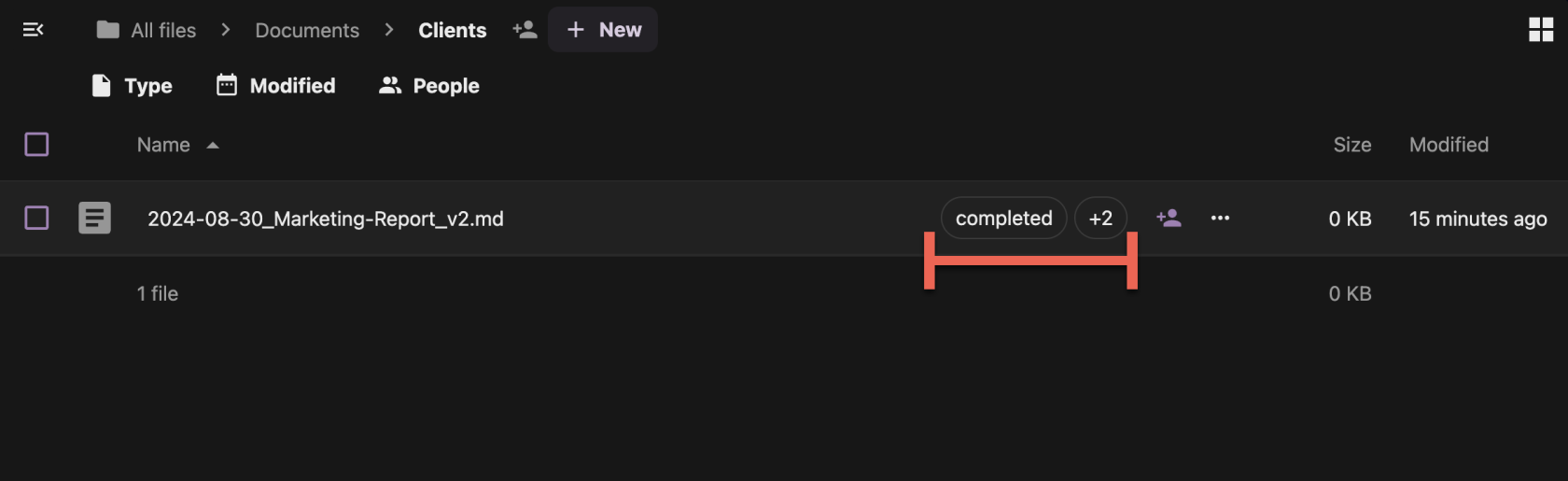
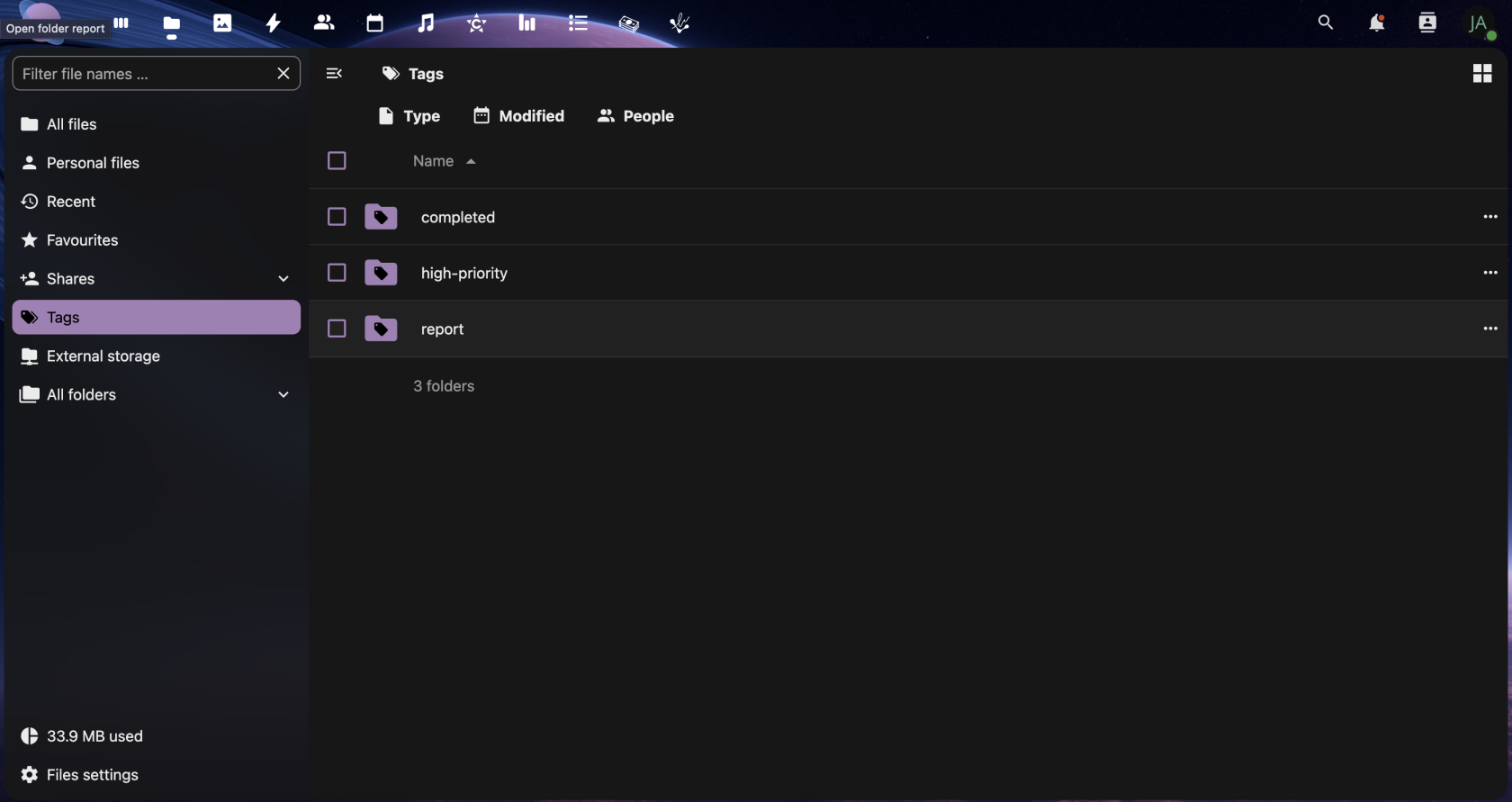
Tags act like digital sticky notes that help you categorise files across different folders:
**Tag Examples:**
- **Status:** `urgent`, `completed`, `in-review`, `archived`
- **Type:** `template`, `reference`, `client-work`, `internal`
- **Project:** `website-redesign`, `q4-planning`, `marketing-campaign`
- **Priority:** `high-priority`, `low-priority`, `routine`
[](https://cdn.eu-west-1.junovy.com/bookstack/uploads/images/gallery/2025-08/SVZimage.png)
### Step 2: Adding Tags to Files
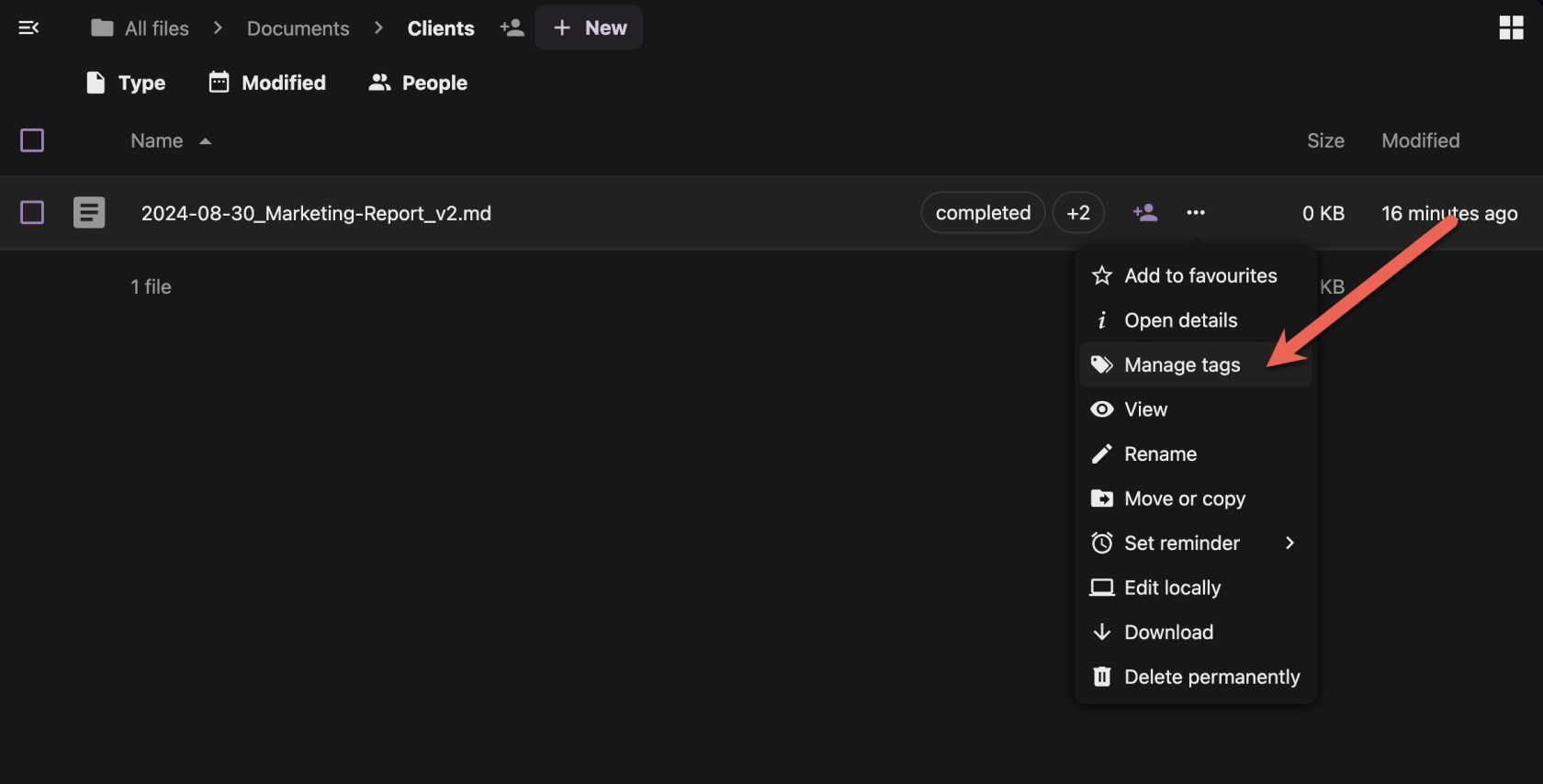
1. **Right-click** any file in your Junovy Cloud Storage
2. Select **"Details"** from the context menu
3. Look for the **"Manage Tags"** section in the details panel
4. **Type your tag** and press Enter
5. Add **multiple tags** by typing each one separately
6. **Save changes** if prompted
[](https://cdn.eu-west-1.junovy.com/bookstack/uploads/images/gallery/2025-08/2yZimage.png)
**Quick Tagging Tips:**
- Start typing and NextCloud will suggest existing tags
- Use consistent tag names across your files
- Create tag categories (status, type, priority) for organisation
- Keep tag names short and descriptive
### Step 3: Creating a Tag System
Develop a consistent tagging strategy for your organisation:
**Status Tags:**
- `draft` - Work in progress
- `review` - Ready for feedback
- `approved` - Finalised content
- `archived` - Old but kept for reference
**Content Tags:**
- `template` - Reusable files
- `reference` - Information resources
- `client-facing` - External documents
- `confidential` - Sensitive information
**Project Tags:**
- Use project codes or names as tags
- Example: `proj-website`, `client-acme`, `campaign-2024`
[](https://cdn.eu-west-1.junovy.com/bookstack/uploads/images/gallery/2025-08/Tokimage.png)
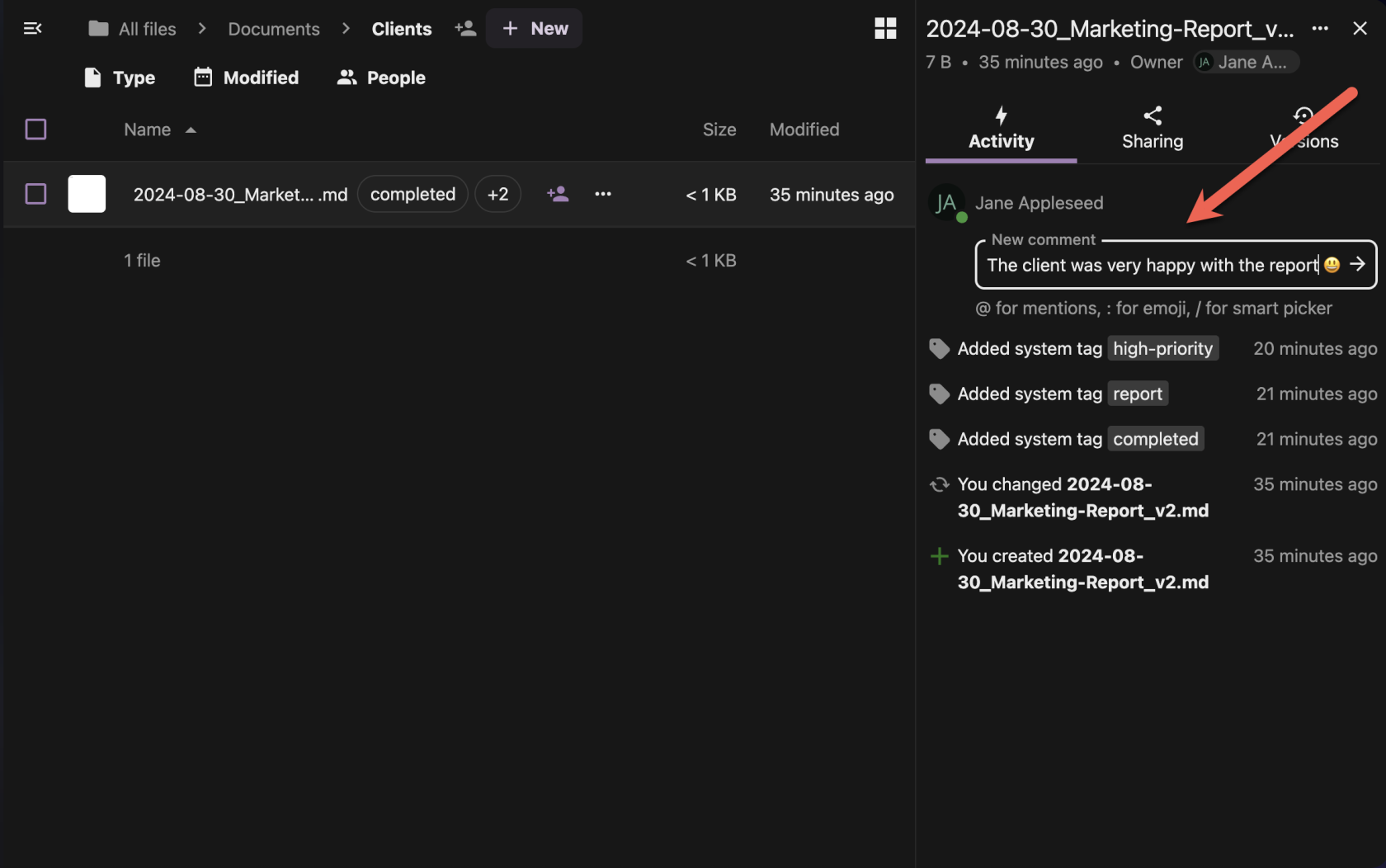
### Step 4: Using Comments for Collaboration
Comments allow team members to discuss files without editing the content:
1. **Open** the file details panel (right-click → View Details)
2. On the **"Activity"** section
3. **Type your comment** in the text box
4. **Mention teammates** using @username for notifications
5. Click the **"Arrow Icon"** or press **ENTER** to add the comment
[](https://cdn.eu-west-1.junovy.com/bookstack/uploads/images/gallery/2025-08/a32image.png)
**Comment Best Practices:**
- **@mention** specific team members for targeted feedback
- **Ask specific questions** rather than general comments
- **Reference line numbers** or sections when commenting on documents
- **Use positive, constructive language** for feedback
### Step 5: Searching with Tags and Metadata
Use your organisational system to find files quickly:
**Tag-Based Searching:**
1. Use the **search bar** at the top of your file view
2. Type **tag:** followed by your tag name
3. Example: `tag:urgent` or `tag:client-acme`
4. **Combine tags** with AND/OR operators
**Advanced Search Options:**
- **Modified date:** `modified:2024-08-30`
- **File type:** `type:pdf` or `type:image`
- **Size range:** `size:>10MB`
- **Author:** `owner:username`
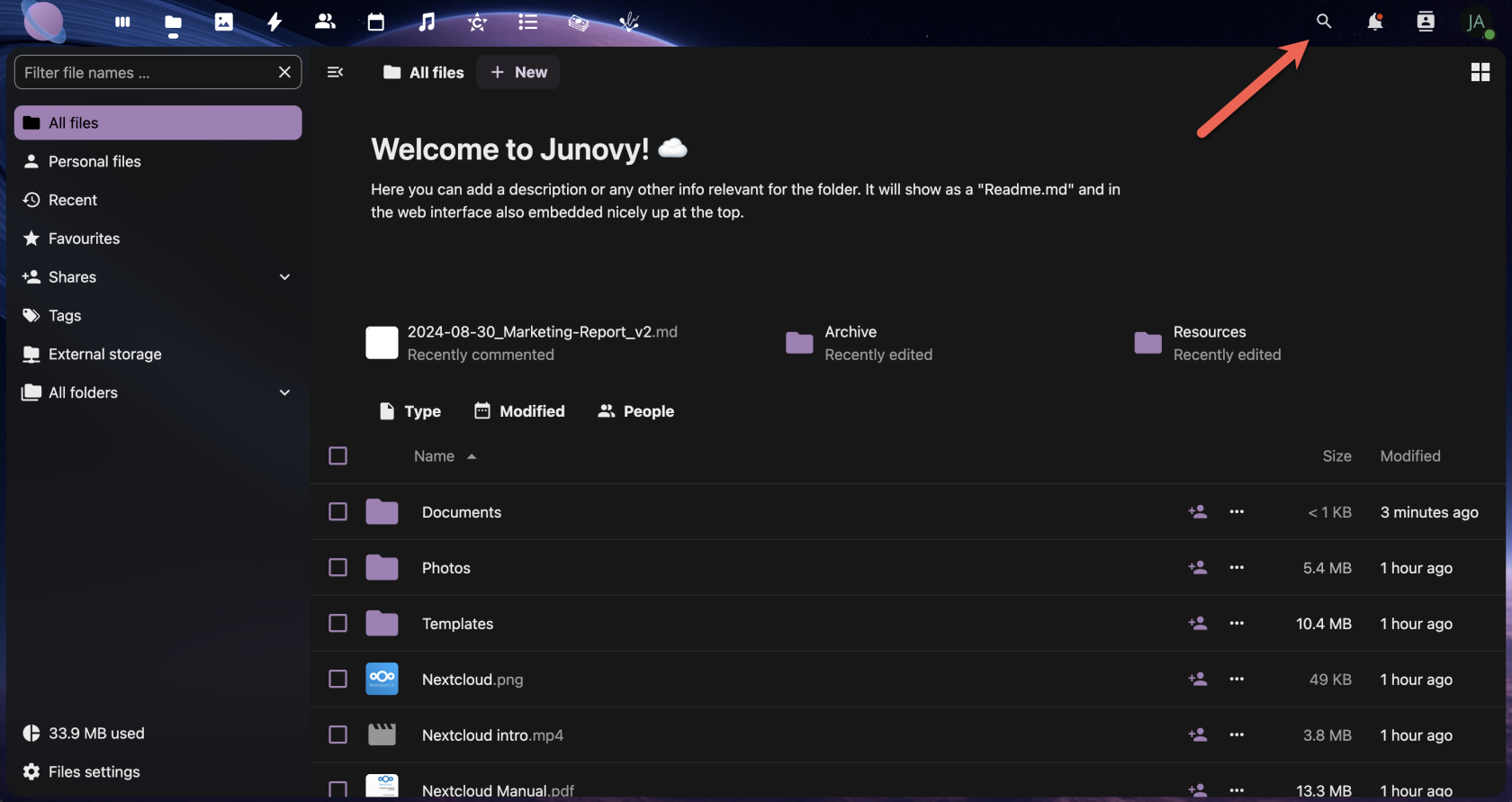
To begin searching, click the search icon in the upper right-hand corner
[](https://cdn.eu-west-1.junovy.com/bookstack/uploads/images/gallery/2025-08/w3Eimage.png)
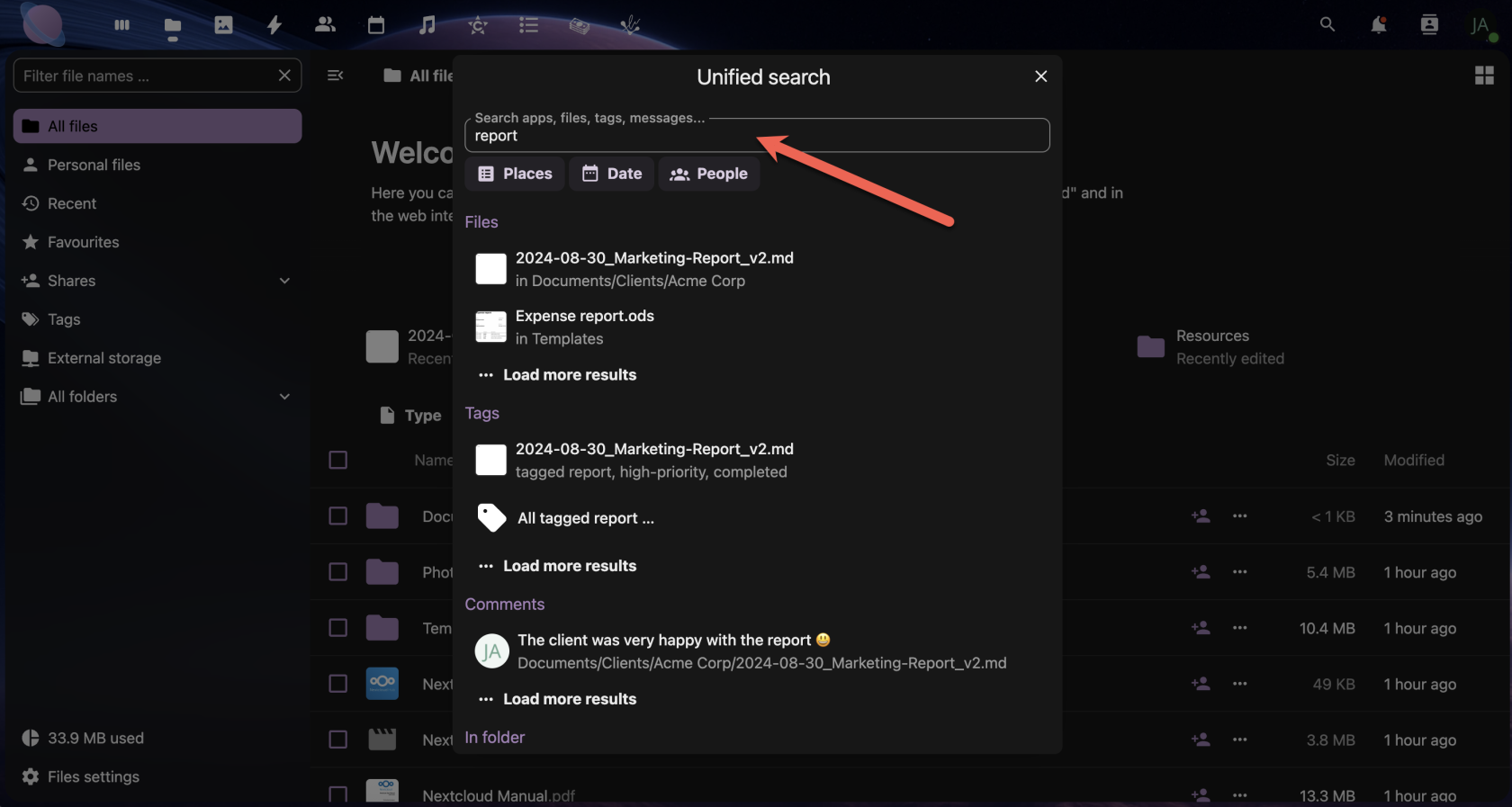
Next, type the keywords or select from one of the options: Places, Date or People. Then, click to select the file.
[](https://cdn.eu-west-1.junovy.com/bookstack/uploads/images/gallery/2025-08/qlcimage.png)
### Step 6: Organising with Favourites
Mark frequently accessed files as favourites for quick access:
1. **Hover** over any file in your file list
2. Click the **star icon** that appears
3. **Access favourites** from the left sidebar
4. **Remove favourites** by clicking the star again
**Use Favourites For:**
- Templates you use regularly
- Important reference documents
- Active project files
- Frequently shared resources
Right-click a file or click the more-options menu to show the **"Add to favourites"** option.
[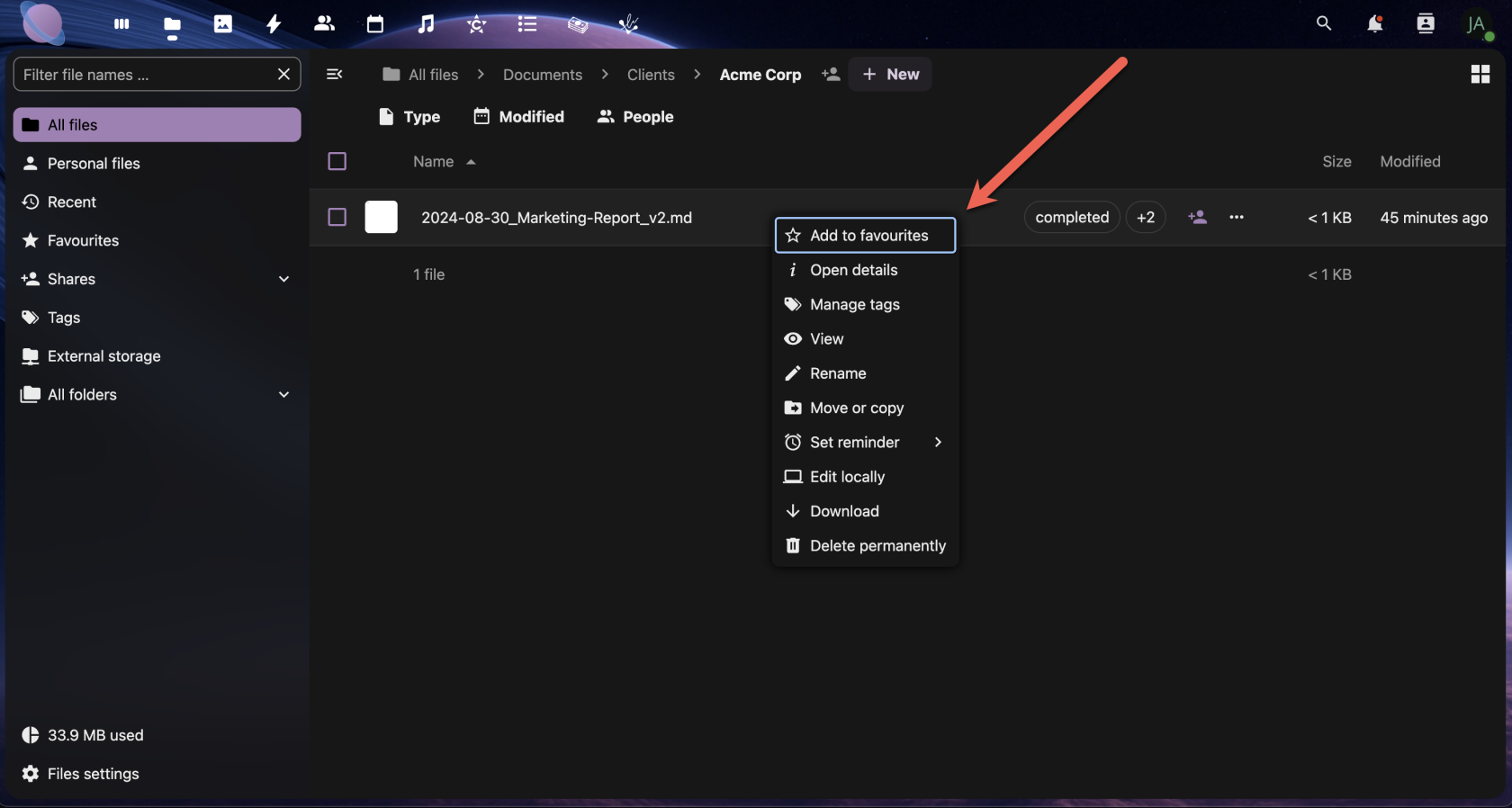](https://cdn.eu-west-1.junovy.com/bookstack/uploads/images/gallery/2025-08/2Xtimage.png)
Once a file is added to favourites, it will show in the **Favourites** panel on the left-hand side panel. The file will also receive a yellow star icon.
[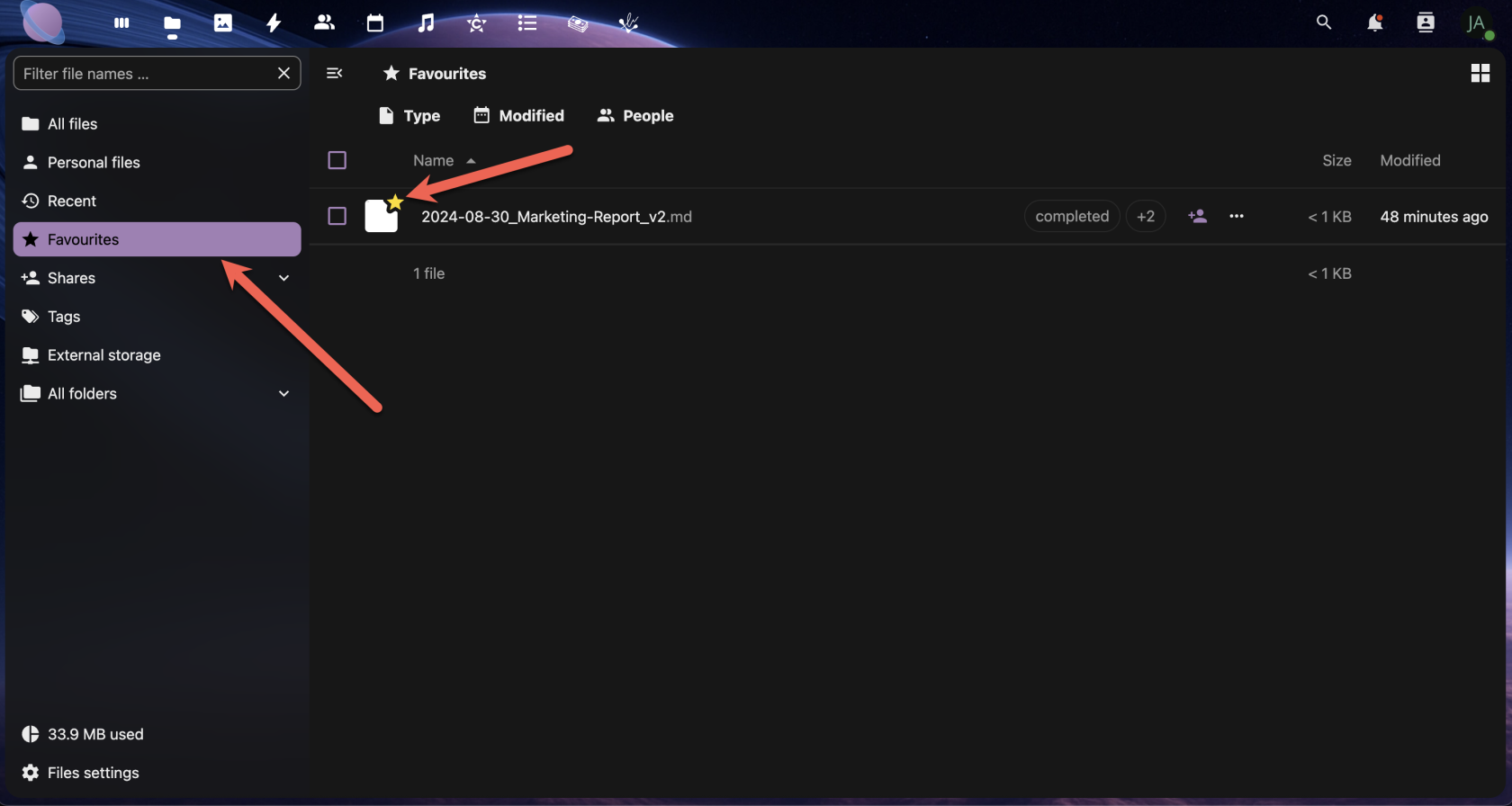](https://cdn.eu-west-1.junovy.com/bookstack/uploads/images/gallery/2025-08/zhRimage.png)
To remove a file from favourites, right-click the file or click the more-options menu to show the **"Remove from favourites"** option.
[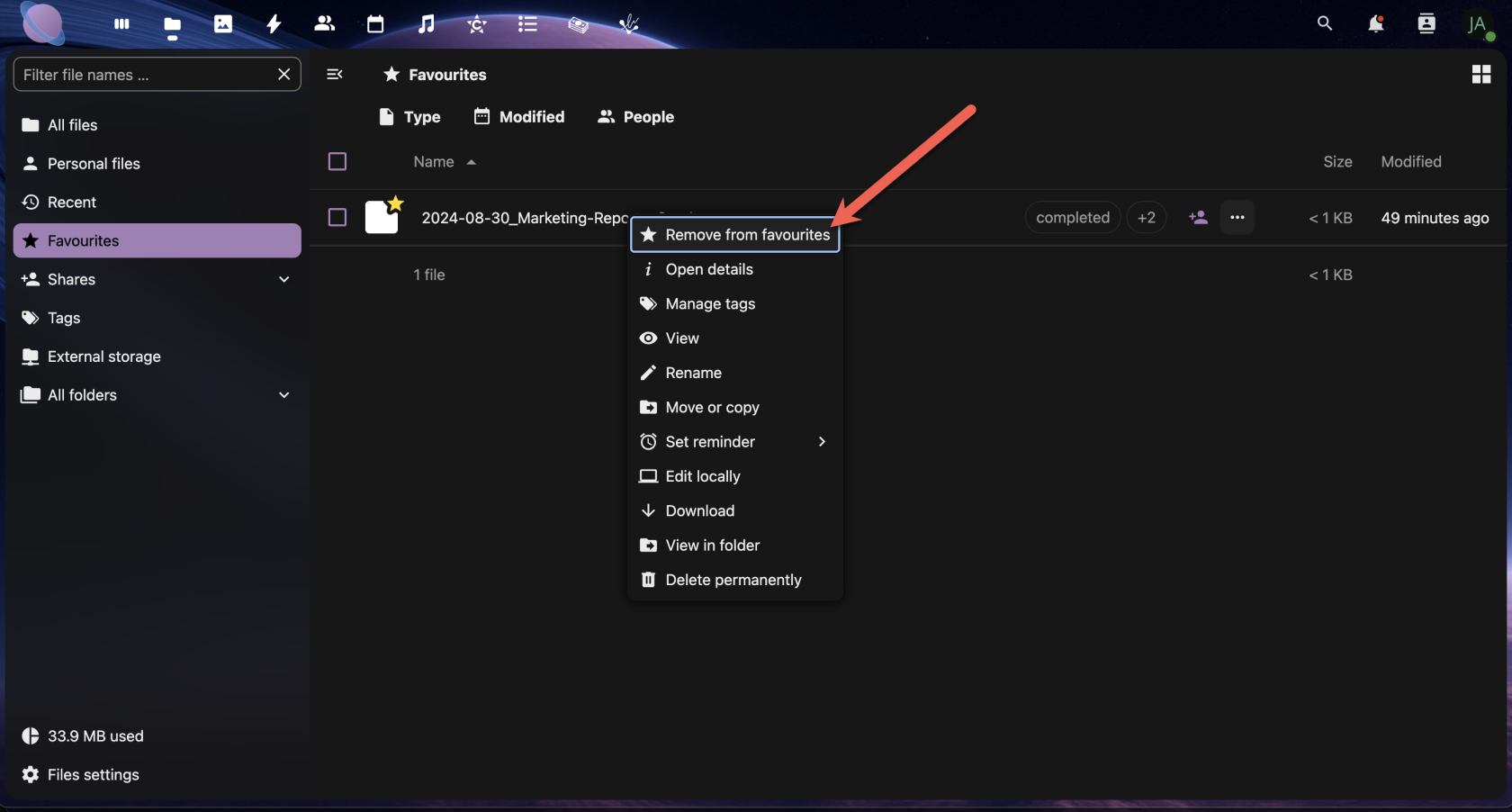](https://cdn.eu-west-1.junovy.com/bookstack/uploads/images/gallery/2025-08/ssaimage.png)
## Step 9: Bulk Metadata Operations
Apply tags and comments to multiple files at once:
1. **Select multiple files** using Ctrl+click (Windows/Linux) or Cmd+click (Mac)
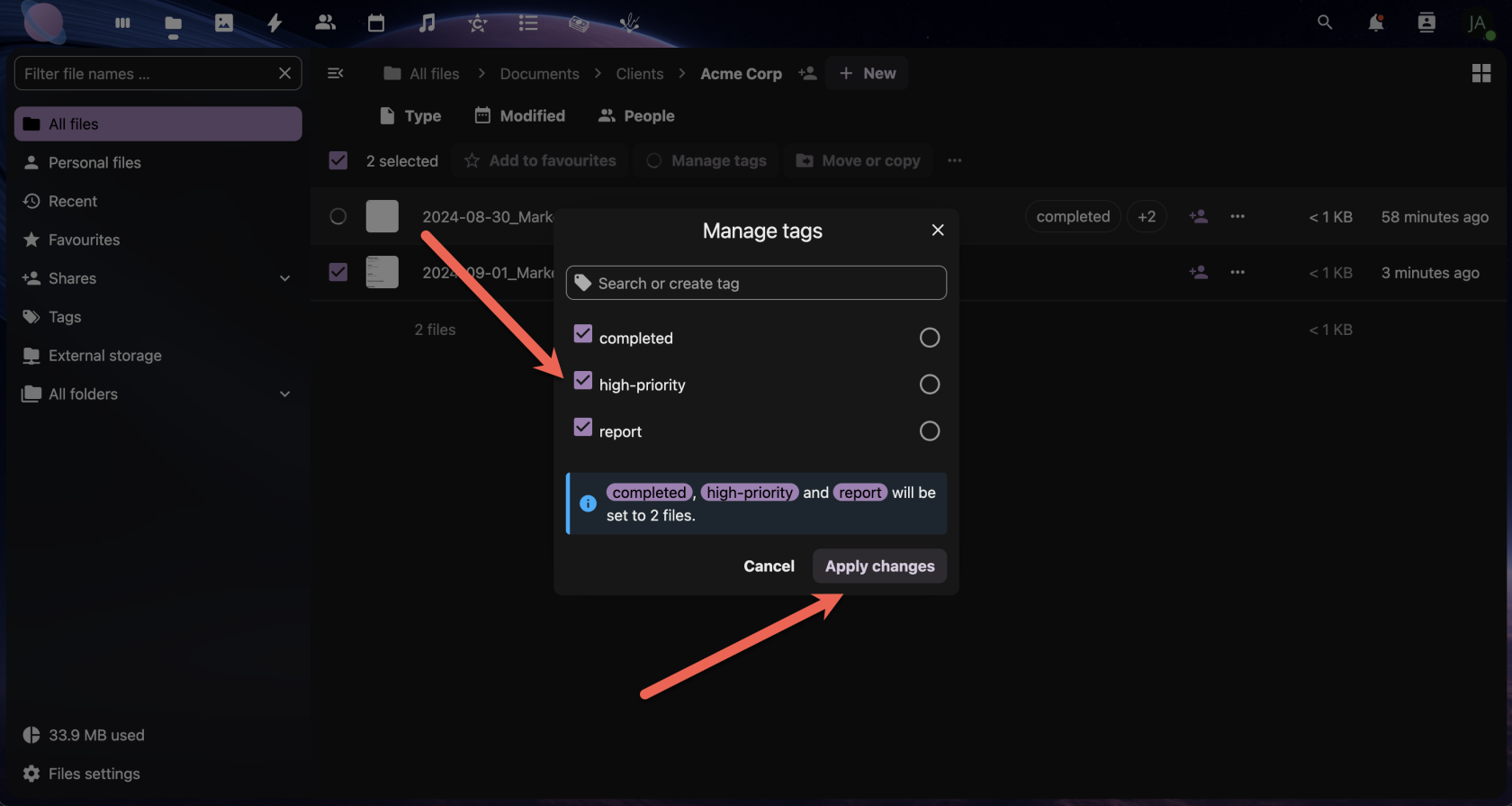
2. Click the **Manage tags** button.
3. **Add tags** that apply to all selected files
4. **Note:** Comments are typically file-specific
**Bulk Tagging Examples:**
- Tag all files from a project: `proj-website-redesign`
- Mark old files for archiving: `archive-candidate`
- Identify file types: `template`, `reference`, `working-file`
[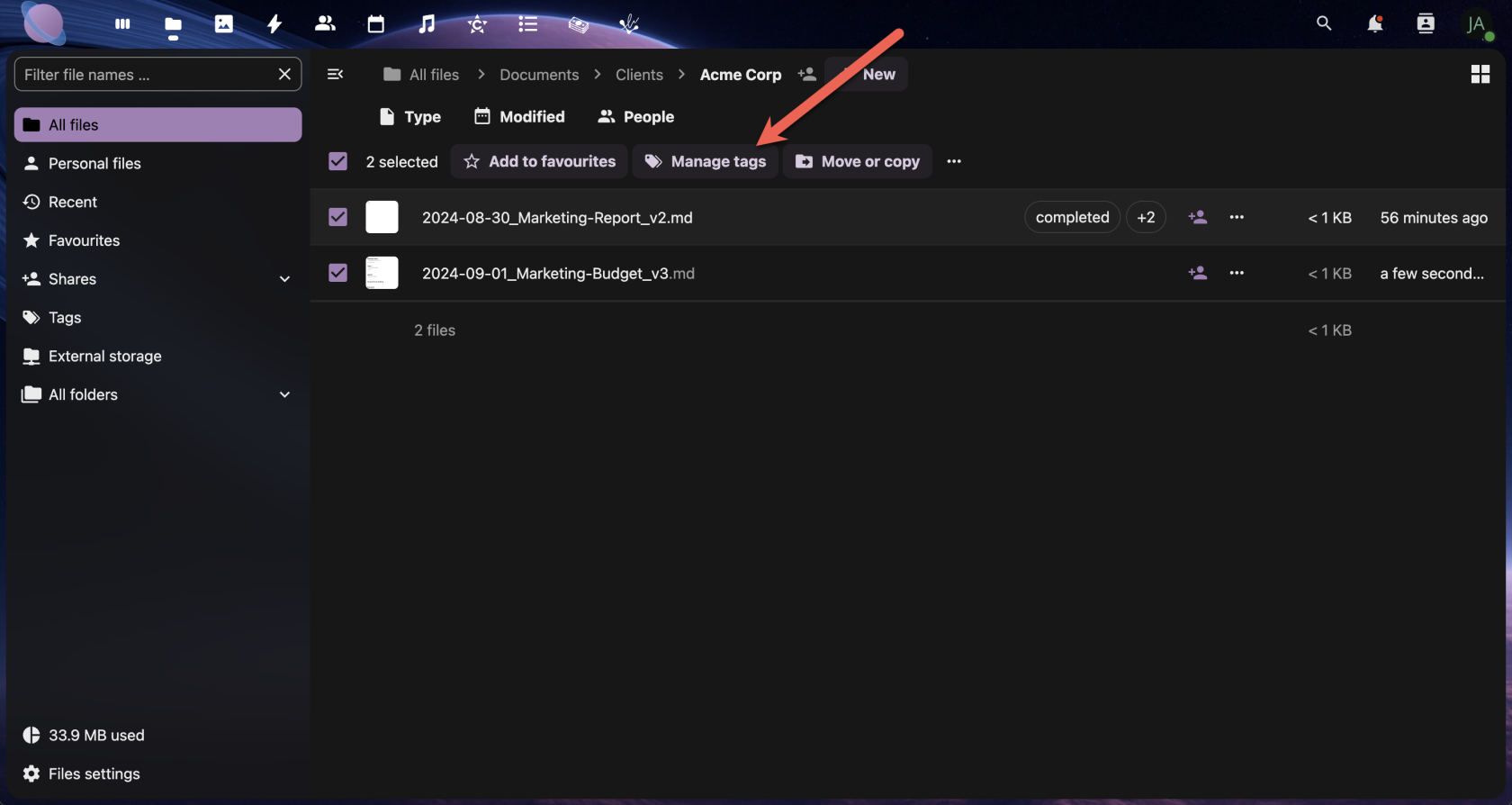](https://cdn.eu-west-1.junovy.com/bookstack/uploads/images/gallery/2025-08/mBJimage.png)
A **Manage Tags** dialog will show and tags can be added or removed from multiple documents. Click the **Apply Changes** button to save the changes.
[](https://cdn.eu-west-1.junovy.com/bookstack/uploads/images/gallery/2025-08/YO2image.png)
### Creating Smart Organisation Rules
Combine tags, comments, and metadata for powerful file management:
**Rule Examples:**
- All `template` tagged files go in Templates folder
- Files tagged `review` get weekly follow-up comments
- `Confidential` tagged files require special sharing permissions
- `Archive-candidate` files older than 1 year get moved to Archive
### Best Practices Summary
✅ **Tag Management:**
- Use consistent, descriptive tag names
- Create tag categories (status, type, project)
- Regularly review and clean up unused tags
- Train team members on your tag system
✅ **Comment Guidelines:**
- Be specific and actionable in feedback
- Use @mentions to notify relevant team members
- Keep comment threads focused on the file topic
- Archive old comment threads when resolved
✅ **Metadata Optimisation:**
- Add descriptions to important documents
- Use keywords that complement your filename
- Keep descriptions concise but informative
- Update metadata when file purposes change
## Next Steps
You now have a comprehensive system for organising files using folders, names, tags, comments, and favourites. The next page will show you how to use these organisational tools to set up effective sharing and collaboration workflows with your team members and clients.
# Sharing and Collaboration Workflows
Now that you've mastered file organisation, it's time to leverage these systems for effective sharing and collaboration. This page shows you how to create secure, organised workflows that make working with team members and clients seamless.
### Understanding NextCloud Sharing Options
NextCloud v31 offers several sharing methods, each suited for different collaboration needs:
**Internal Sharing:** Share with other Junovy Cloud Storage users **Link Sharing:** Create shareable links for external access **Email Sharing:** Send files directly via email **Group Sharing:** Share with predefined user groups **Federated Sharing:** Share with users on other NextCloud instances
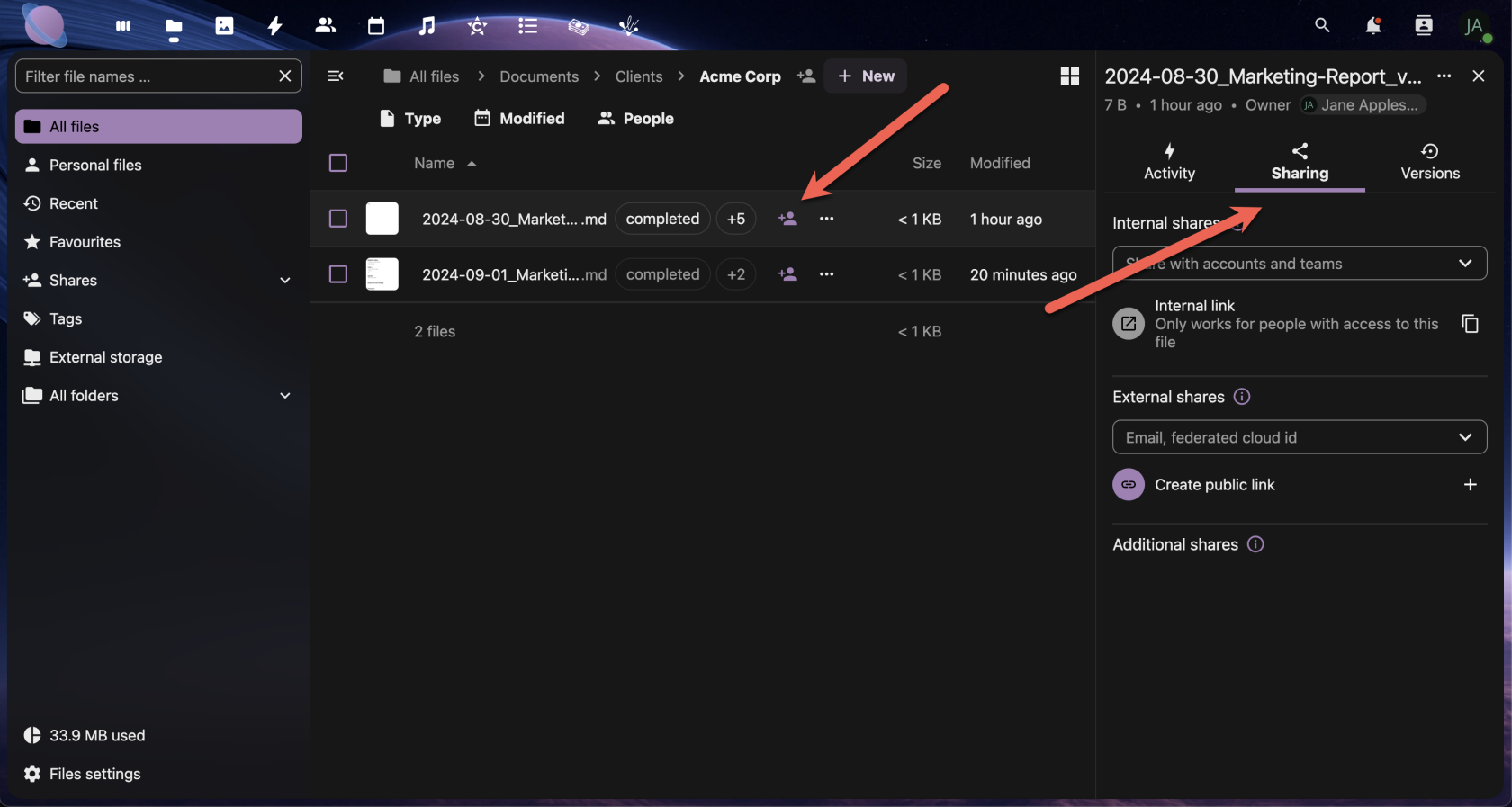
Clicking the **Sharing Options** icon, the **Sharing** menu will open.
[](https://cdn.eu-west-1.junovy.com/bookstack/uploads/images/gallery/2025-08/mEwimage.png)
### Step 1: Set Up Your Collaboration Folders
Create dedicated spaces for different types of collaboration:
**Recommended Folder Structure:**
```
02 - Shared Projects/
├── Client-Collaboration/
│ ├── ACME-Website/
│ ├── Johnson-Co-Branding/
│ └── Templates-for-Clients/
├── Team-Workspaces/
│ ├── Marketing-Team/
│ ├── Development-Team/
│ └── Management-Reports/
└── External-Partners/
├── Freelancer-Handoffs/
└── Vendor-Resources/
```
1. **Create** your collaboration folder structure
2. **Apply consistent tagging** to shared folders
3. **Set clear naming conventions** for shared content
4. **Document permissions** for each collaboration space
### Step 2: Internal Team Sharing
Share files and folders with your Junovy Cloud Storage team members:
#### Sharing with Individual Users:
1. **Right-click** the file or folder you want to share
2. Select **"Share"** from the context menu
3. In the **"Share with users"** field, start typing a colleague's name
4. **Select their name** from the dropdown
5. **Choose permissions:**
- **View only** - Can see and download
- **Allow editing** - Can modify files
- **Custom permissions** - Can share with others and change permissions
6. Click **"Share"**
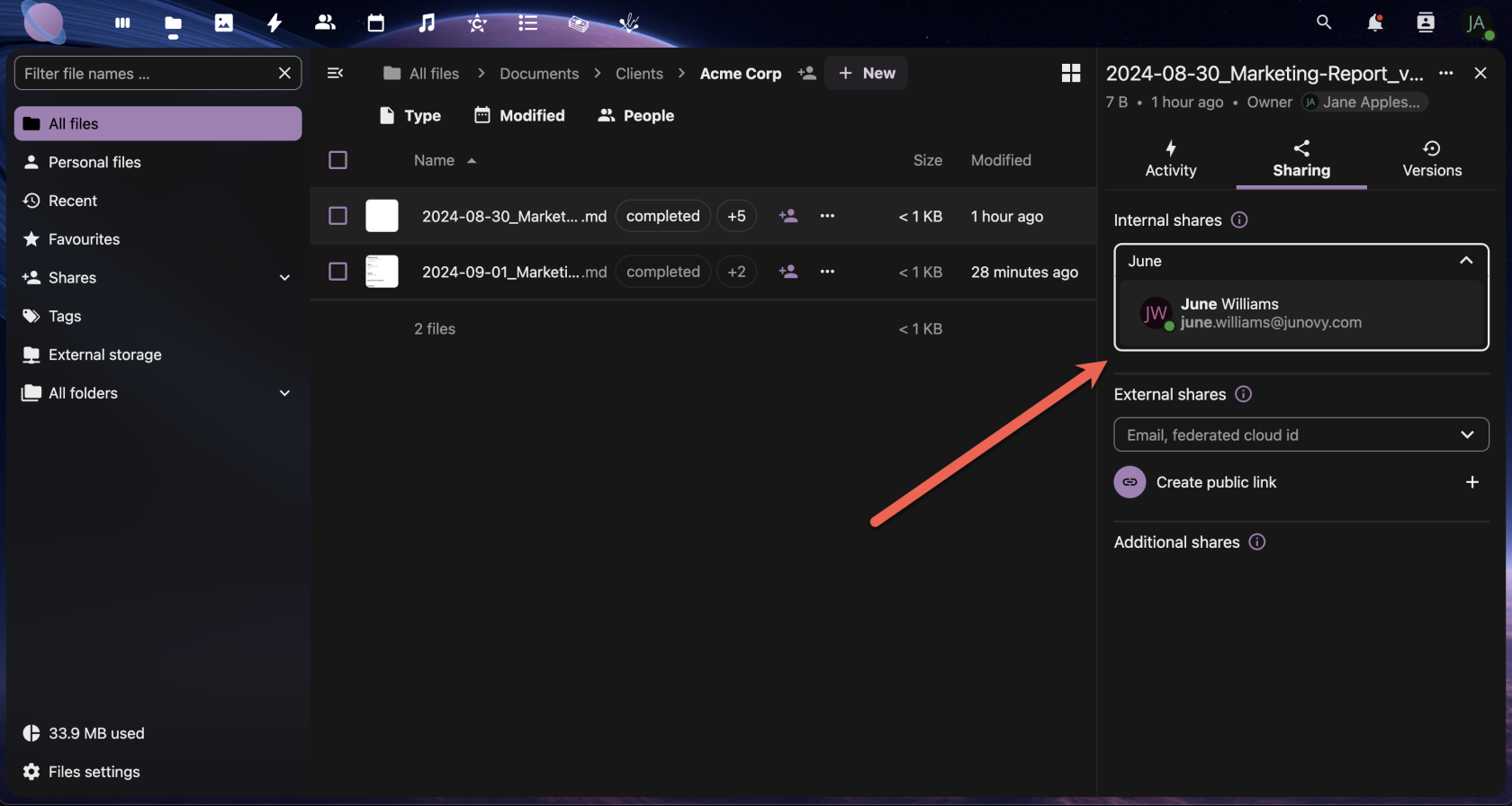
To share internally, being typing the user's name and then click to select it.
[](https://cdn.eu-west-1.junovy.com/bookstack/uploads/images/gallery/2025-08/GhSimage.png)
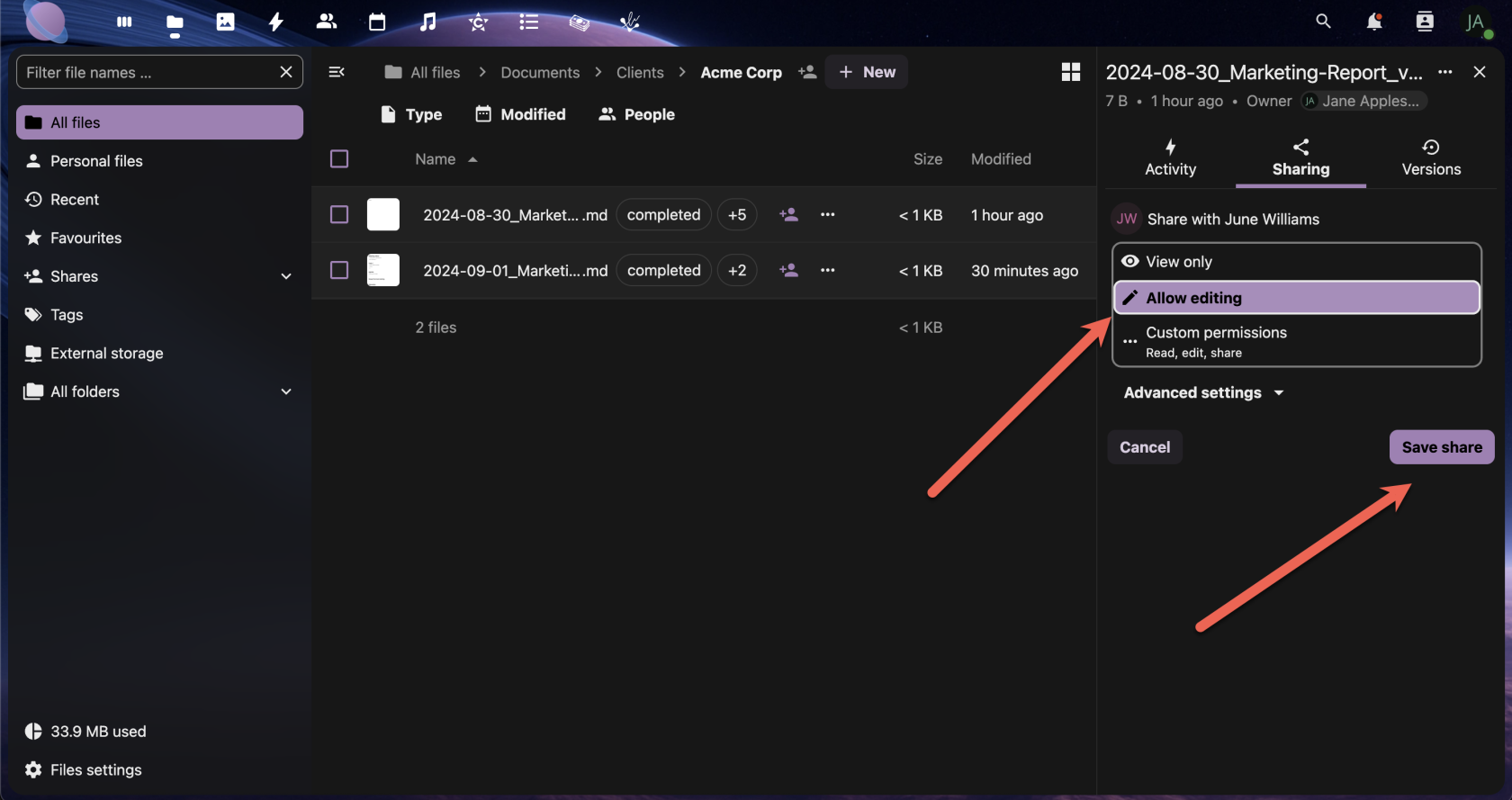
Once the user is selected, choose between **View only**, **Allow editing**, or **Custom Permissions**. Then click **Save share**.
[](https://cdn.eu-west-1.junovy.com/bookstack/uploads/images/gallery/2025-08/rQYimage.png)
Once a share has been created, the share can be managed by clicking on the **Quick Share Permissions** drop-down menu or the **More Options** menu on the right-hand side.
[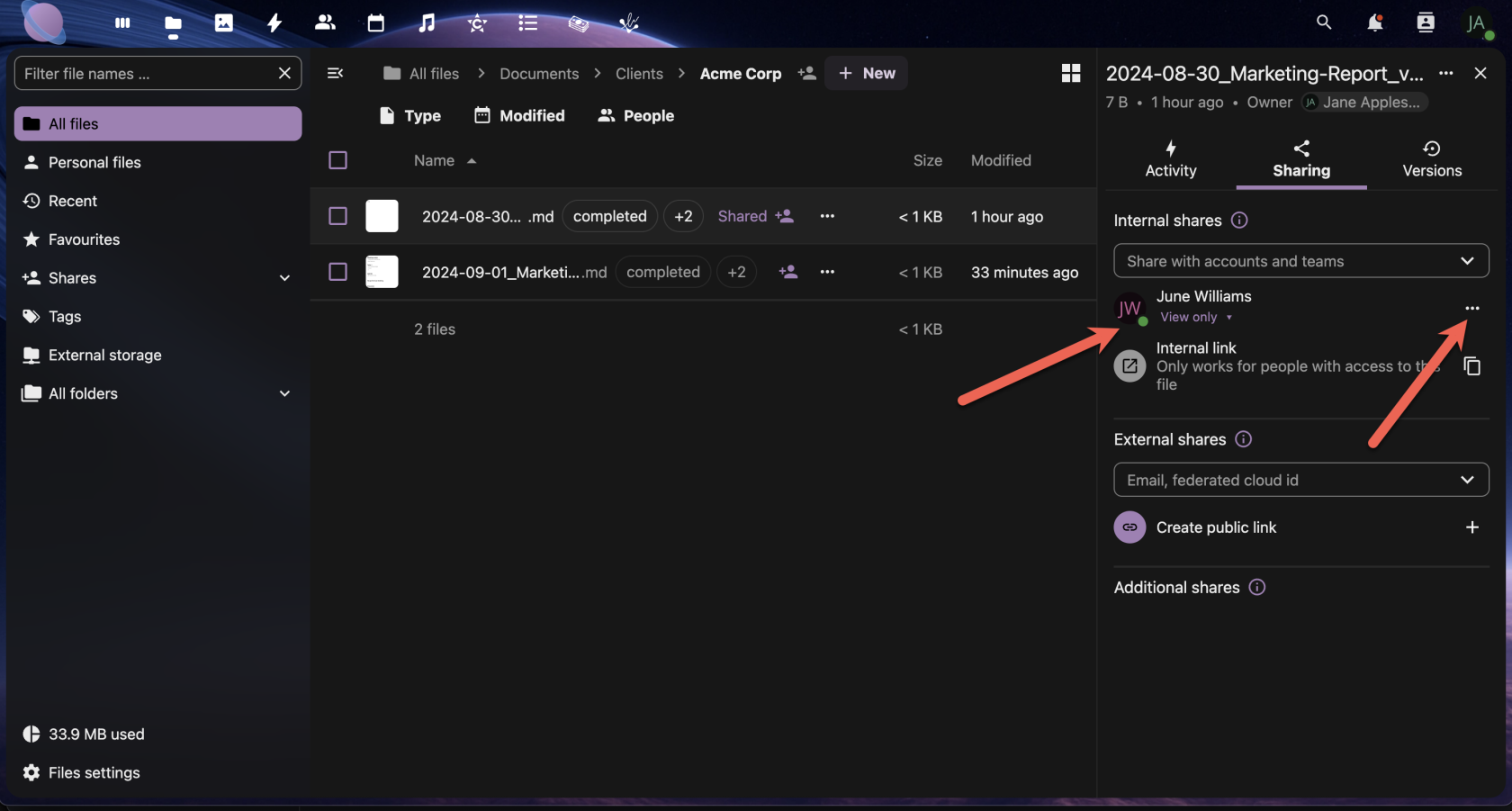](https://cdn.eu-west-1.junovy.com/bookstack/uploads/images/gallery/2025-08/917image.png)
The **Quick Share Permissions** drop-down menu can be used to quickly switch between **View only, Can edit**, and **Custom permissions.**
[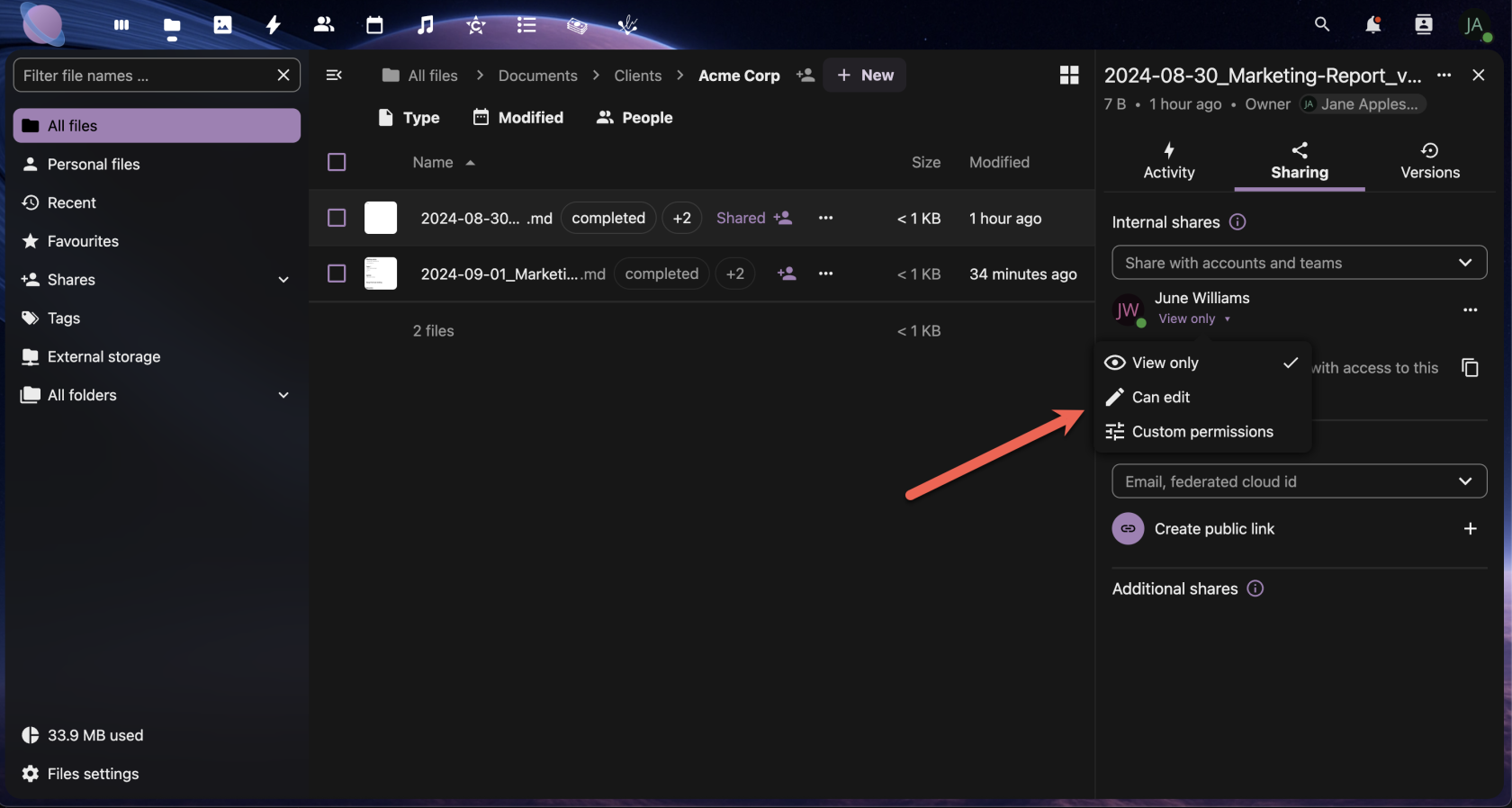](https://cdn.eu-west-1.junovy.com/bookstack/uploads/images/gallery/2025-08/gk8image.png)
#### Removing A Share
To remove a share, click on the **More Options** menu on the right-hand side of the file share.
[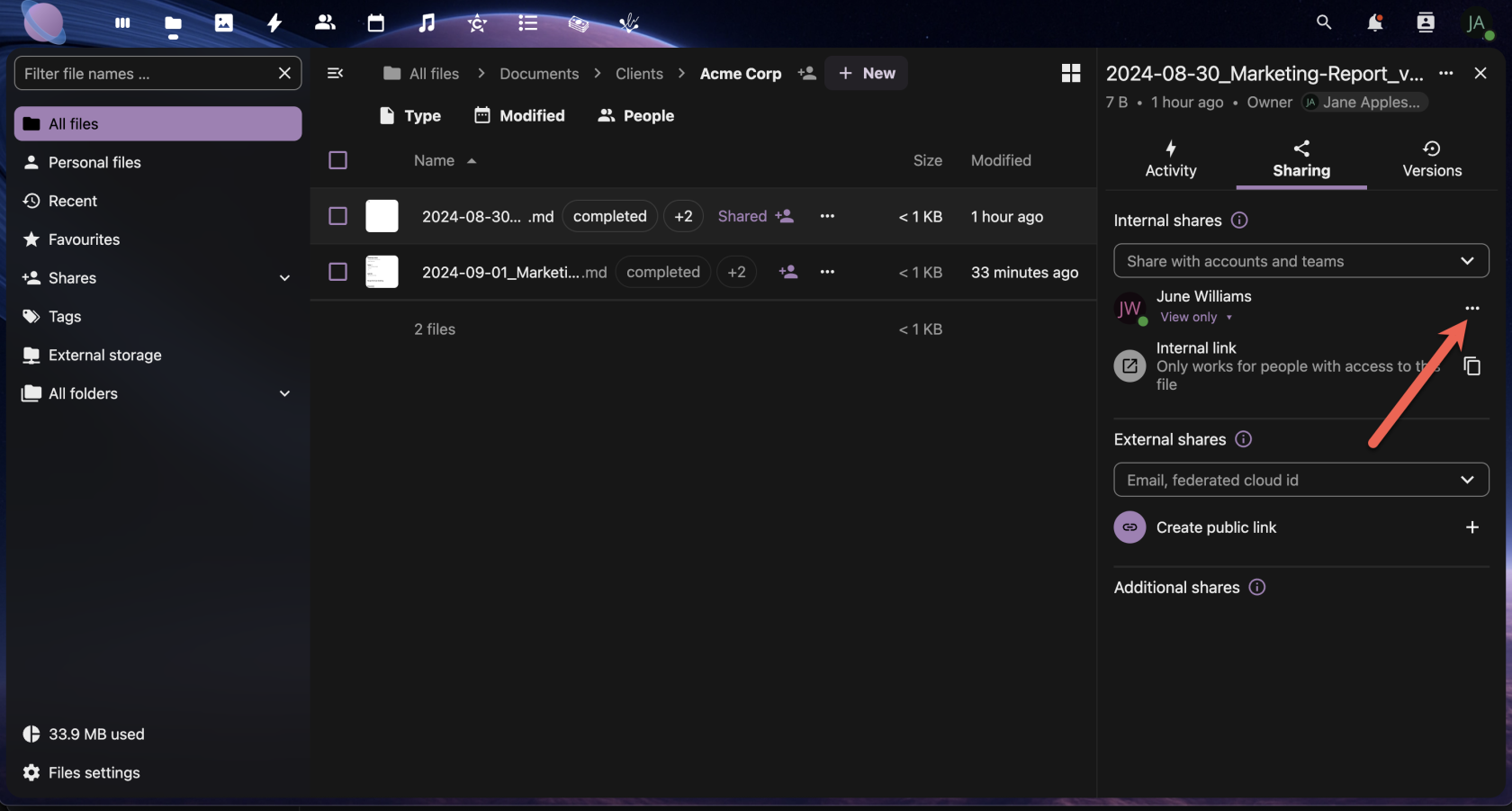](https://cdn.eu-west-1.junovy.com/bookstack/uploads/images/gallery/2025-08/kLyimage.png)
This will open up the **Sharing** panel. Click the **Delete share** button to remove the share.
[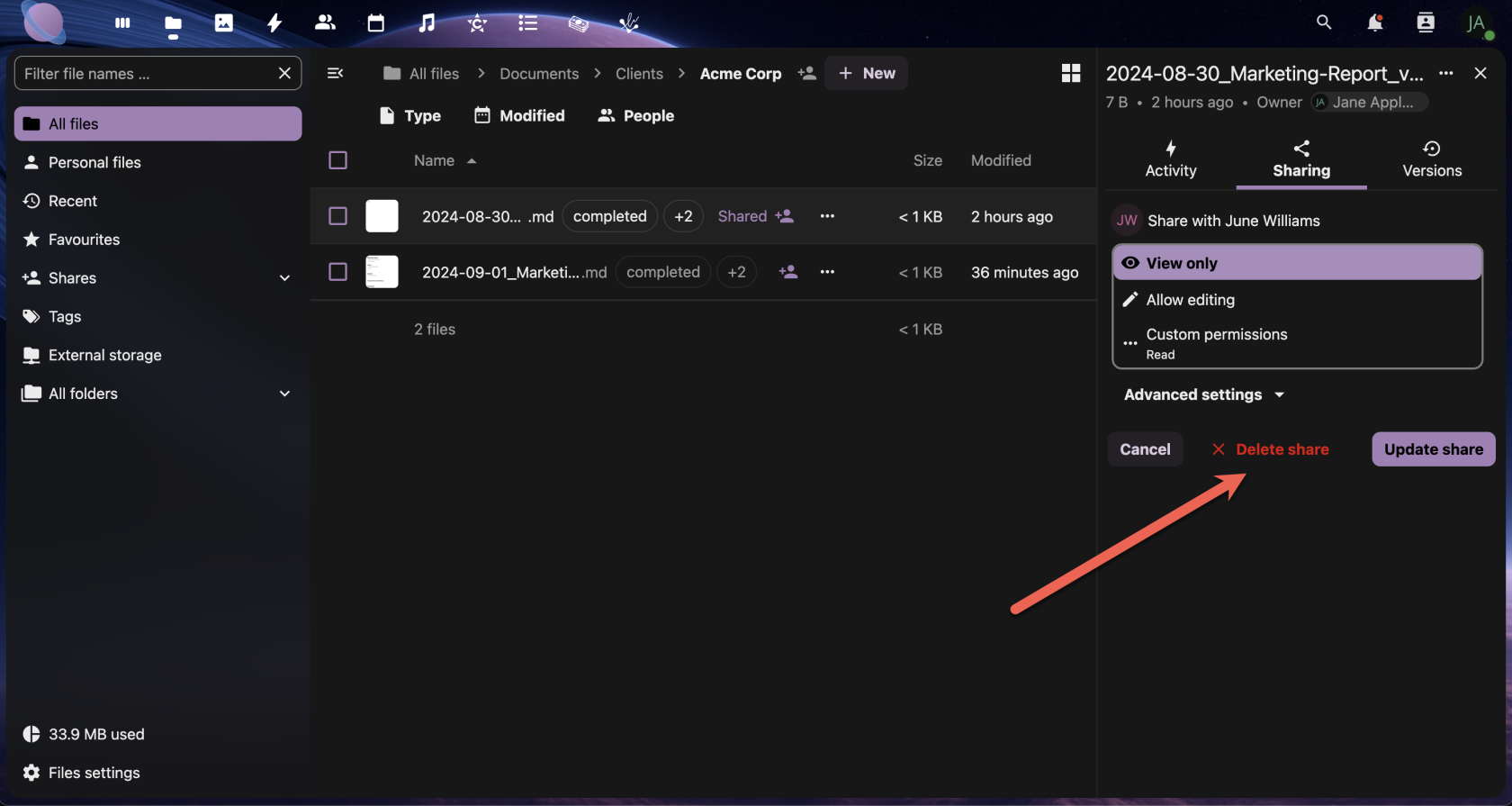](https://cdn.eu-west-1.junovy.com/bookstack/uploads/images/gallery/2025-08/YZCimage.png)
### Step 3: Client Collaboration Workflows
Create secure, professional workflows for external client collaboration:
#### Option A: Secure Public Link Sharing
1. **Select** the folder you wish to share.
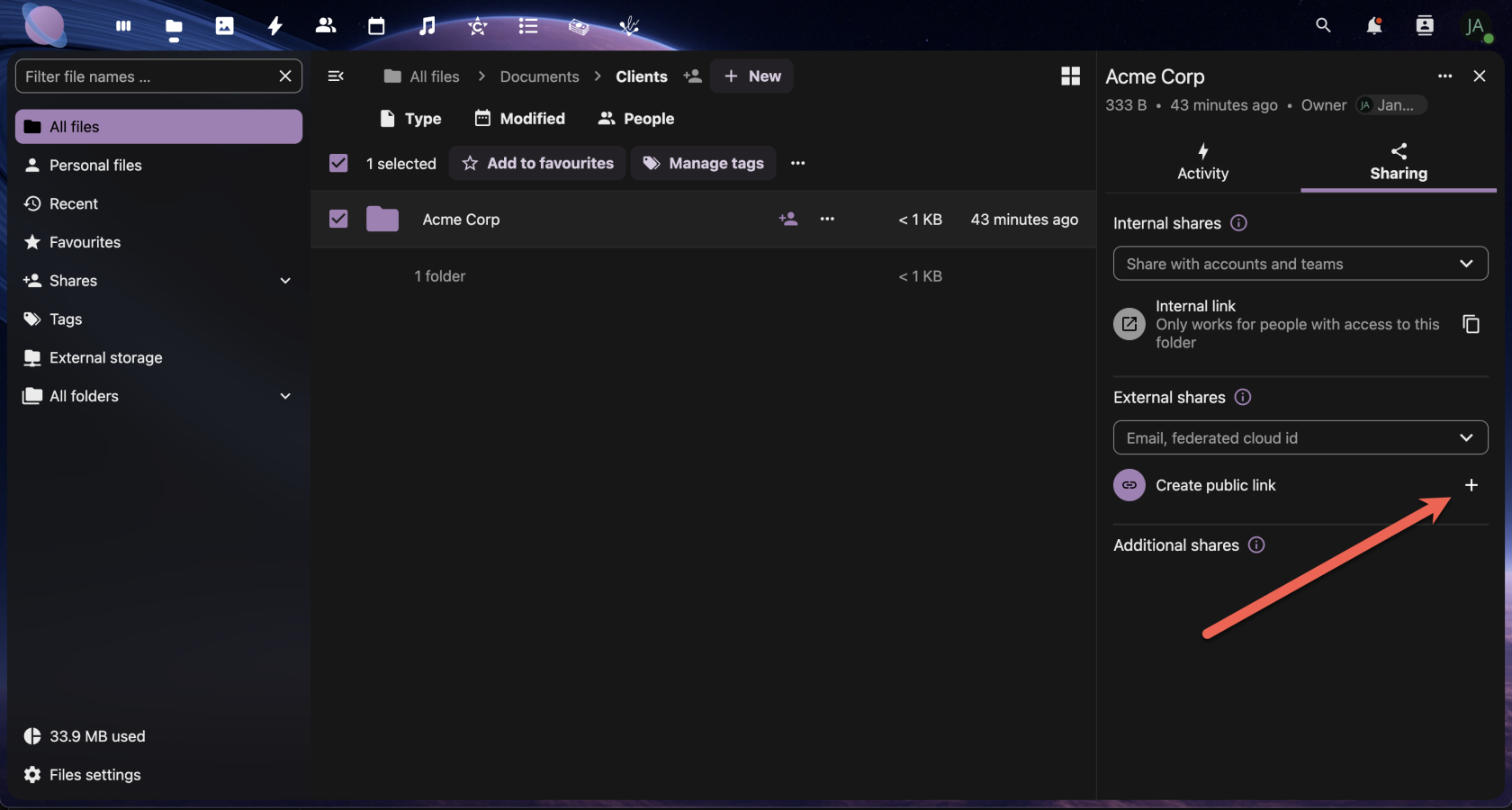
2. Select **"Sharing"** → **"Create Public Link"**
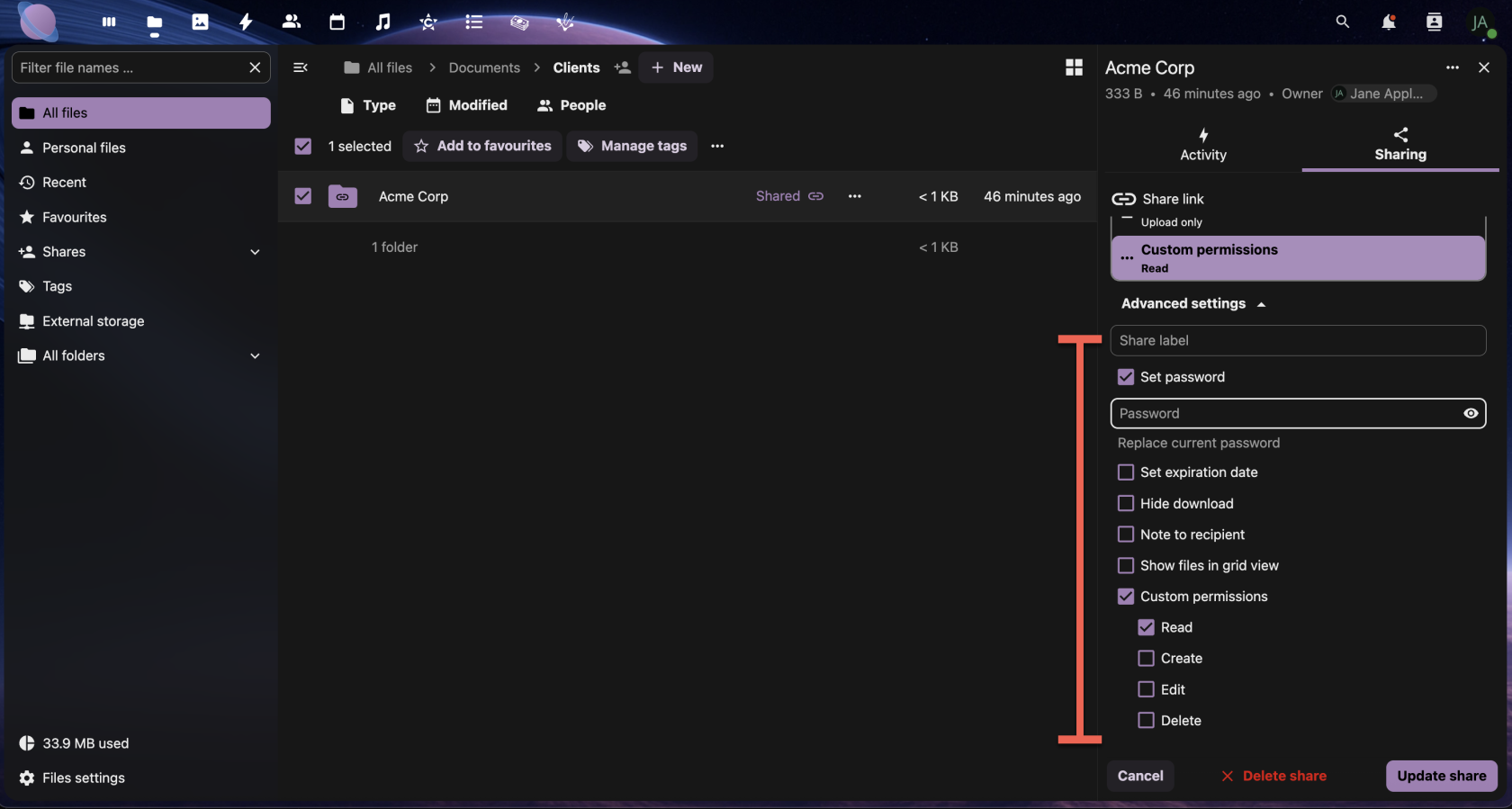
3. **Configure link settings:**
- **Password protection** (recommended for clients)
- **Expiration date** (set project timeline)
- **Permission level** (usually "View and download")
- **Allow upload** (if clients need to provide files)
4. **Copy the link** and send it securely to your client
A public link can be generated with specific permissions.
[](https://cdn.eu-west-1.junovy.com/bookstack/uploads/images/gallery/2025-08/chximage.png)
Next, select which options should be allowed with the public link. These options are explained in detail on the [Custom Permissions for Public Shares](https://support.junovy.com/books/junovy-cloud-storage/page/custom-permissions-for-public-shares). Please read this before sharing files publicly.
[](https://cdn.eu-west-1.junovy.com/bookstack/uploads/images/gallery/2025-08/kxeimage.png)
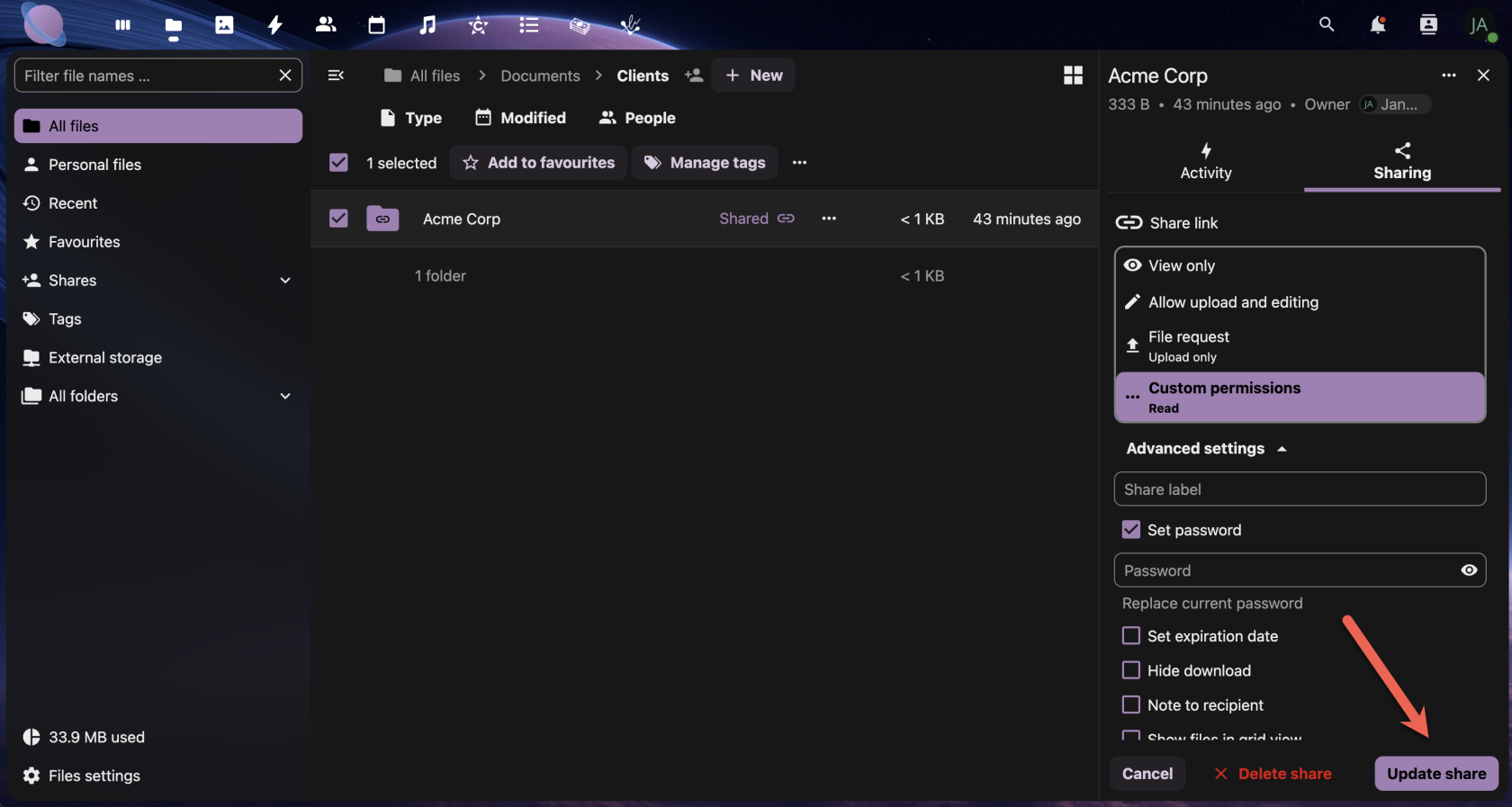
Once complete, select **Update share**.
[](https://cdn.eu-west-1.junovy.com/bookstack/uploads/images/gallery/2025-08/nzsimage.png)
#### Option B: Direct Client Access
1. **Create a client-specific folder** (e.g., "ACME-Client-Portal")
2. **Share via email** directly from NextCloud
3. **Set appropriate permissions** (typically view-only)
4. **Include a welcome message** explaining how to use the shared space
#### Client Folder Best Practices:
- **Organise by project phase:** Planning → Design → Development → Final
- **Include a README file** with instructions and contact information
- **Use clear, professional folder names** that clients will understand
- **Regularly clean up** old or irrelevant files
### Step 4: Permission Management
Set appropriate permissions for different collaboration scenarios:
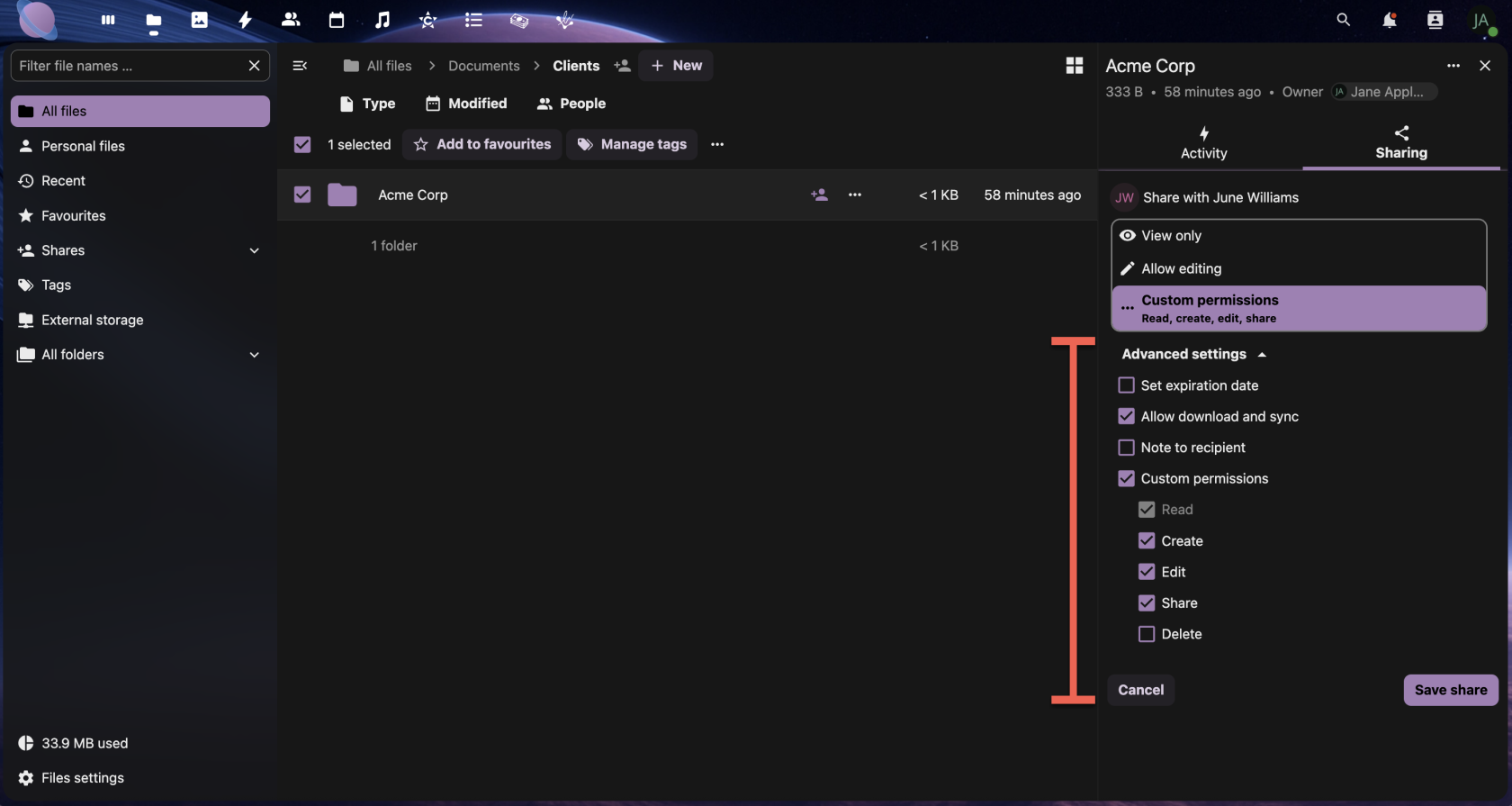
**Permission Levels in Junovy Cloud Storage:**
**Read (View):**
- View files and folders
- Download content
- **Use for:** Final deliverables, reference materials
**Write (Edit):**
- All read permissions plus
- Upload files
- Edit existing files
- **Use for:** Active collaboration, shared workspaces
**Share:**
- All write permissions plus
- Share with other users
- Change permissions
- **Use for:** Project managers, team leads
**Delete:**
- All share permissions plus
- Delete files and folders
- **Use for:** Folder owners, administrators
[](https://cdn.eu-west-1.junovy.com/bookstack/uploads/images/gallery/2025-08/hHHimage.png)
### Step 5: Collaborative File Editing
Set up workflows for real-time collaboration on documents:
#### For Office Documents:
1. **Enable collaborative editing** in your NextCloud apps
2. **Share documents** with edit permissions
3. **Use version comments** when saving significant changes
4. **Establish editing protocols** (who edits when, how to handle conflicts)
#### For Design Files:
1. **Share design folders** with appropriate team members
2. **Use version numbering** in filenames for design iterations
3. **Create feedback folders** for client comments and revisions
4. **Maintain asset libraries** in shared template folders
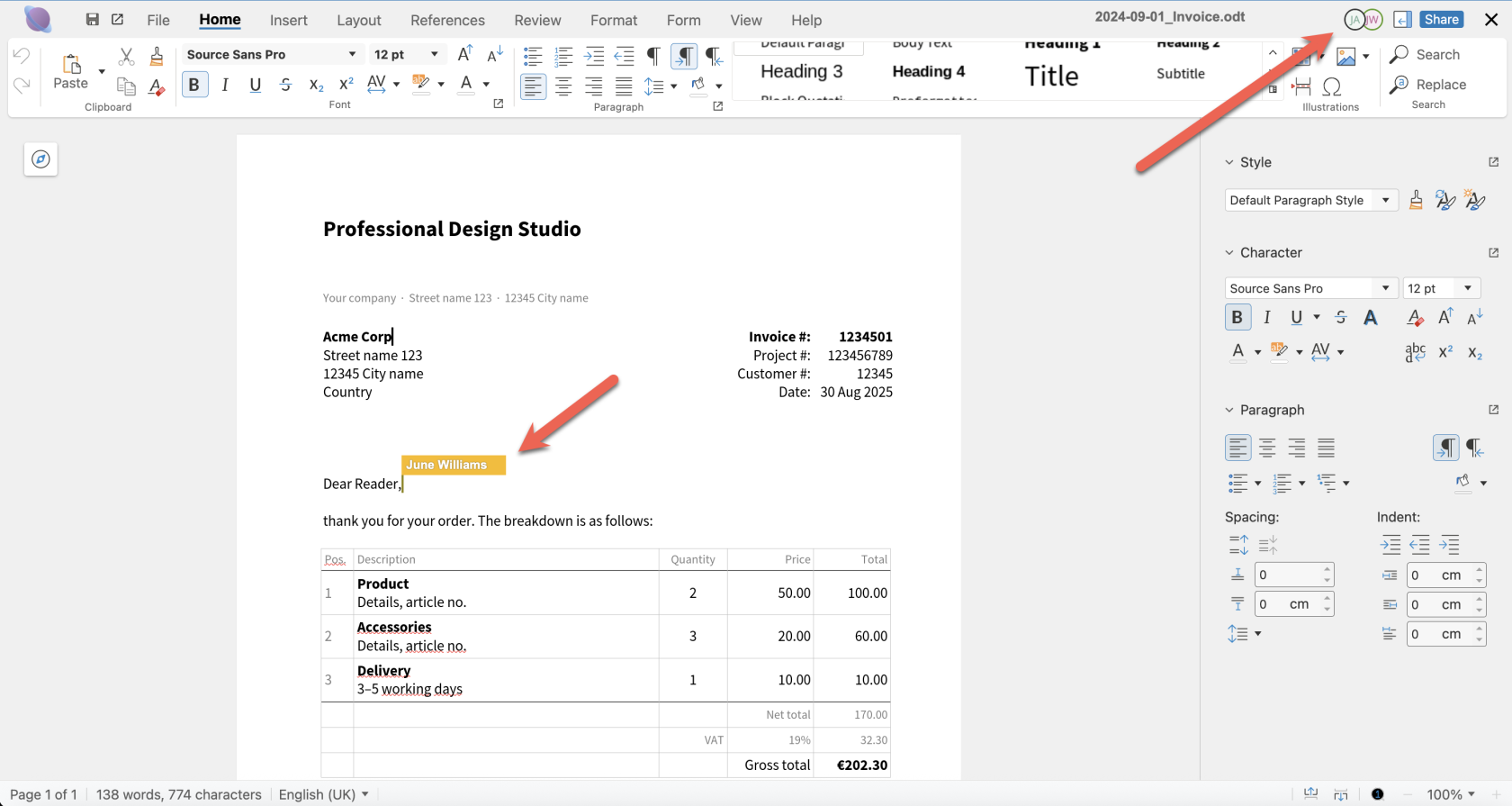
When more than two users have a file open, the other user's cursor will display with their name. If the document has been opened by more than one user, this will be shown in the upper right-hand corner of the screen.
[](https://cdn.eu-west-1.junovy.com/bookstack/uploads/images/gallery/2025-08/V0Mimage.png)
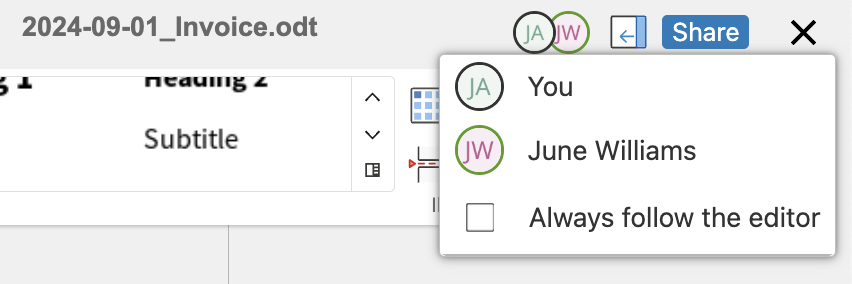
Clicking the user icons, display a list of users who are currently viewing or editing the document.
[](https://cdn.eu-west-1.junovy.com/bookstack/uploads/images/gallery/2025-08/GIeimage.png)
### Step 6: Notification and Communication
Stay informed about shared file activity:
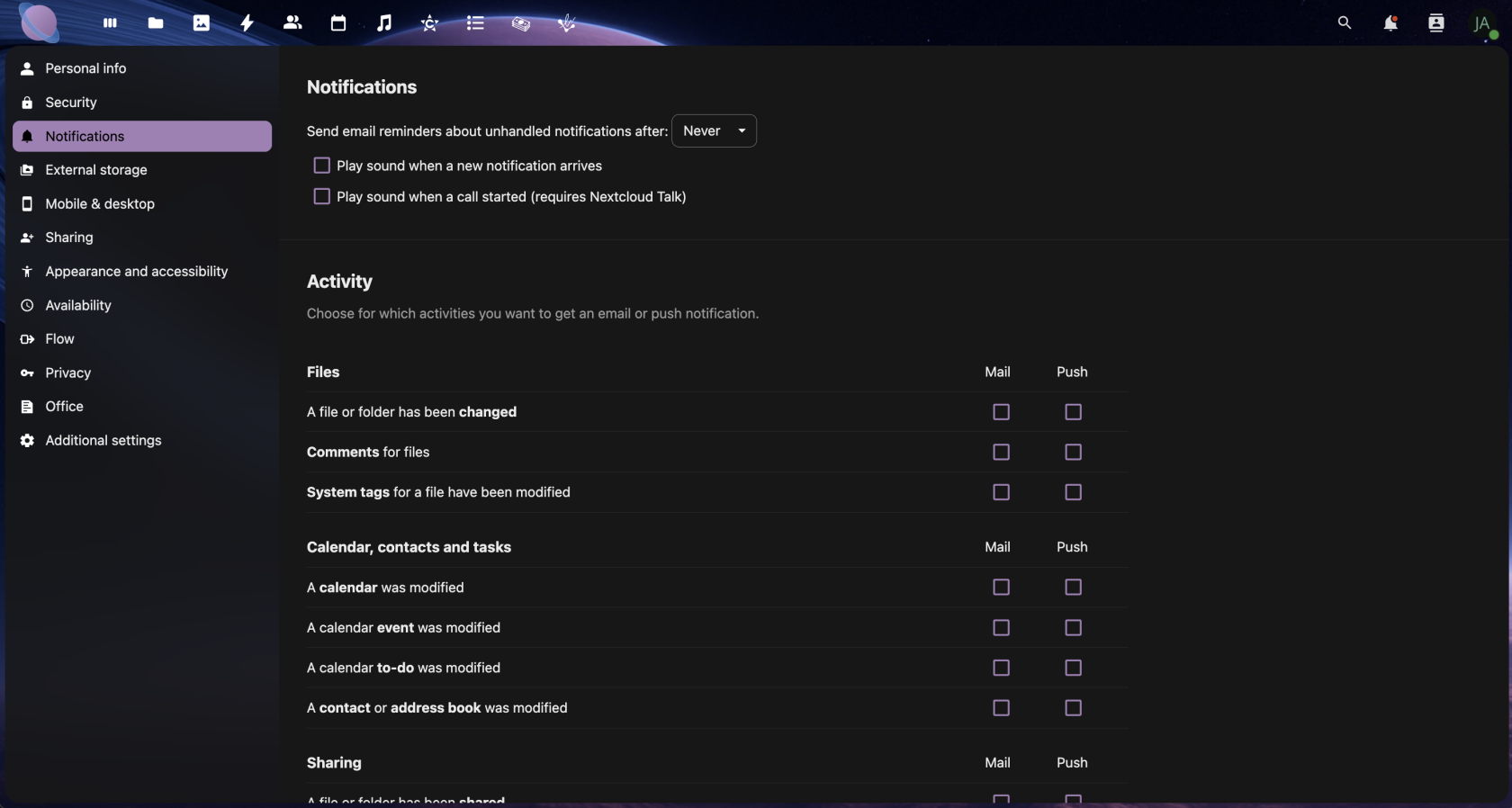
#### Setting Up Notifications:
1. **Go to Settings** → **Personal** → **Activity**
2. **Configure notifications** for:
- File changes in shared folders
- New comments (if comments app enabled)
- Share invitations and acceptances
- File uploads to your shared folders
#### Communication Protocols:
- **Use file names** to communicate status (DRAFT-, REVIEW-, FINAL-)
- **Organise by urgency** using folder prioritisation
- **Send notification emails** for important updates
- **Schedule regular reviews** of shared spaces
[](https://cdn.eu-west-1.junovy.com/bookstack/uploads/images/gallery/2025-08/sDXimage.png)
### Step 7: External Sharing Security
Implement security best practices for external collaboration:
#### Security Checklist:
✅ **Always use passwords** for external links
✅ **Set expiration dates** on temporary shares
✅ **Review permissions regularly** and remove unnecessary access
✅ **Use view-only permissions** unless editing is required
✅ **Monitor sharing activity** through the activity feed
✅ **Create separate folders** for different external parties
#### Advanced Security Options:
- **IP restrictions** (if available in your NextCloud setup)
- **Two-factor authentication** requirements for shared access
- **Watermarking** for sensitive documents (premium feature)
- **Audit trails** for compliance requirements
### Step 8: Workflow Templates
Create reusable sharing workflows for common scenarios:
#### Project Kickoff Template:
1. **Create project folder** with standard substructure
2. **Share with internal team** (edit permissions)
3. **Create client portal folder** (view permissions)
4. **Set up progress tracking** folder for milestones
5. **Document sharing protocols** in project README
#### Client Delivery Template:
1. **Organise final deliverables** in clear folder structure
2. **Create shareable link** with password protection
3. **Include delivery documentation** and usage instructions
4. **Set appropriate expiration** (typically 30-90 days)
5. **Archive project files** after successful delivery
### Step 9: External File Shares
NextCloud's External Storage feature allows you to connect and access files from external services directly within your Junovy Cloud Storage interface. This powerful feature is available as an add-on for Business subscriptions and higher.
#### What Are External File Shares?
External file shares let you mount external storage services as if they were native folders in your Junovy Cloud Storage:
**Supported External Storage Types:**
- **FTP/SFTP** - Connect to FTP servers and web hosting accounts
- **SMB/CIFS** - Access Windows network shares and corporate file servers
- **Google Drive** - Mount your existing Google Drive storage
- **Dropbox** - Access Dropbox files without leaving NextCloud
- **OneDrive** - Connect Microsoft OneDrive accounts
- **Amazon S3** - Mount S3 buckets for cloud storage
- **WebDAV** - Connect to other WebDAV-compatible services
#### Business & Enterprise Subscription Requirement
**Important:** External file shares are available as an add-on feature for Business and Enterprise subscriptions. If you're interested in connecting external storage services to your Junovy Cloud Storage, please contact our support team to discuss adding this feature to your account.
#### Setting Up External File Shares (Business & Enterprise Add-on)
Once the external storage add-on is enabled on your account:
1. **Navigate** to Settings → Personal → External Storage
2. **Click "Add storage"** and select your desired service type
3. **Configure the connection:**
- **Service credentials** (API keys, usernames, passwords)
- **Mount point name** (how it appears in your file list)
- **Access permissions** (read-only or read-write)
- **User availability** (personal or shared with team)
4. **Test the connection** to ensure proper configuration
5. **Save settings** to mount the external storage
#### External Share Use Cases
**Development Workflows:**
- Mount client FTP servers for direct website file management
- Access version control repositories through SFTP
- Connect to staging servers for seamless file deployment
**Business Integration:**
- Access existing Google Drive or OneDrive files without migration
- Connect to company network drives (SMB/CIFS) for legacy file access
- Mount backup storage (S3) for additional file redundancy
**Client Collaboration:**
- Provide clients access to their existing cloud storage within your project workspace
- Connect to client FTP servers for asset gathering and delivery
- Integrate with client's preferred cloud storage platforms
#### Managing External Shares
**Best Practices for External Storage:**
- **Use descriptive mount names** like "Client-FTP-Server" or "Company-Google-Drive"
- **Set appropriate permissions** (read-only for reference materials)
- **Monitor connection status** regularly to ensure availability
- **Document external connections** for team members
- **Consider security implications** of connecting external services
**Performance Considerations:**
- External files may load slower than local NextCloud storage
- Large file operations work best with stable internet connections
- Consider syncing frequently used external files to local storage
#### Security and External Storage
**Security Best Practices:**
✅ **Use service accounts** rather than personal accounts for business connections
✅ **Apply least-privilege access** (read-only when possible)
✅ **Monitor external storage activity** through NextCloud logs
✅ **Regularly review connected services** and remove unused connections
✅ **Ensure external services** meet your security and compliance requirements
**Data Sovereignty:** Remember that external file shares store data on third-party services. Consider data location and compliance requirements when connecting external storage, especially for sensitive business information.
### Collaboration Workflow Examples
#### Marketing Campaign Workflow:
```
Campaign-Q4-Launch/
├── 01-Strategy/ (Team: Edit, Client: View)
├── 02-Creative/ (Designers: Edit, Others: View)
├── 03-Approval/ (Client: Edit for feedback)
└── 04-Final/ (All: View only)
```
#### Website Development Workflow:
```
Website-Project/
├── Discovery/ (Team + Client: Edit)
├── Design/ (Designers: Edit, Client: View + Comment)
├── Development/ (Developers: Edit, Client: View)
└── Launch/ (All: View, Client: Download)
```
### Best Practices Summary
✅ **Organisation:**
- Use consistent folder structures across all shared projects
- Apply your tagging system to shared content
- Create clear README files for external collaborators
- Maintain separate spaces for different types of collaboration
✅ **Security:**
- Always password-protect external shares
- Set appropriate expiration dates
- Review and audit permissions regularly
- Use the minimum permissions necessary for each role
✅ **Communication:**
- Establish clear workflows and protocols
- Use descriptive file names to communicate status
- Set up relevant notifications for team members
- Document your sharing protocols for team consistency
### Next Steps
With your sharing and collaboration workflows established, you're ready to learn about advanced features like automation, backup strategies, and mobile workflows. The next chapter will cover these power-user features to maximise your Junovy Cloud Storage efficiency.
# Custom Permissions for Public Shares
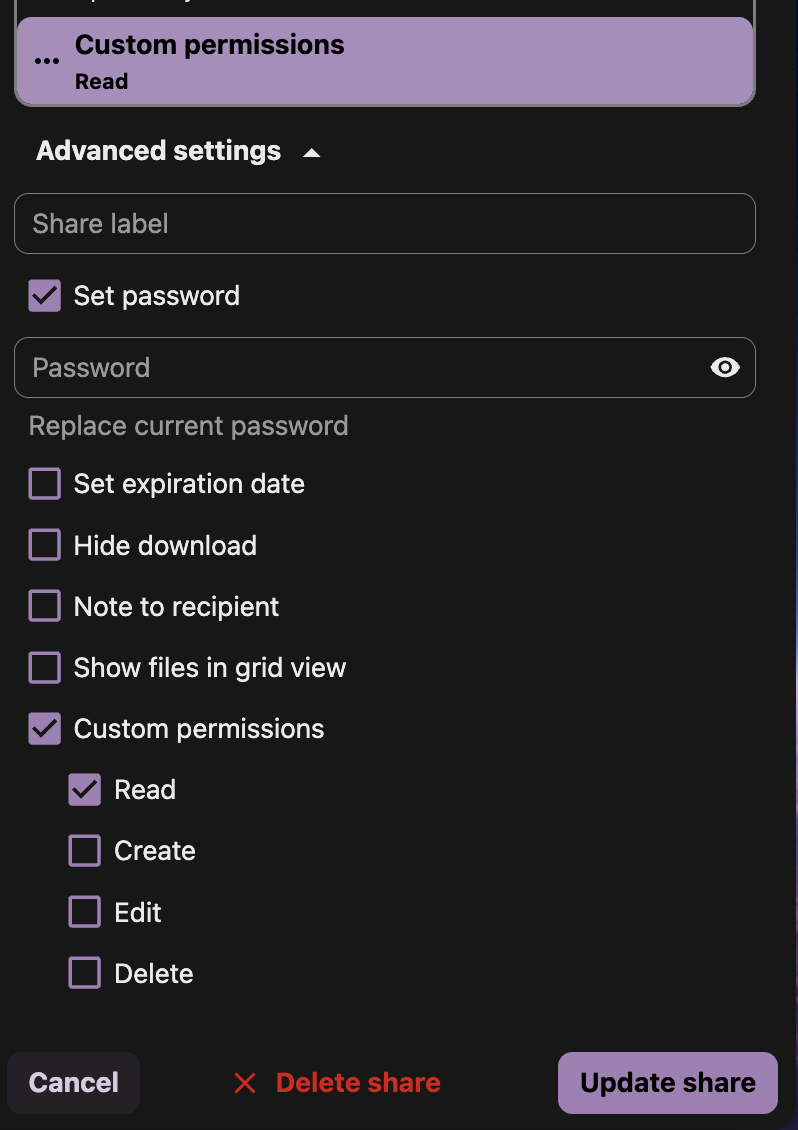
When sharing files or folders via public link, Junovy Cloud Storage offers granular permission controls to ensure recipients have exactly the access they need. Here's what each permission does:
[](https://cdn.eu-west-1.junovy.com/bookstack/uploads/images/gallery/2025-08/6v7image.png)
### Permission Options Explained
**Read**
- Allows recipients to **view and download** files
- **Default permission** for most public shares
- **Use for:** Sharing final deliverables, portfolios, or reference materials
**Create**
- Allows recipients to **upload new files** to shared folders
- Recipients **cannot modify existing files**
- **Use for:** File collection from clients, team submission folders
**Edit**
- Allows recipients to **modify existing files** directly
- **Requires Read permission** to be effective
- **Use for:** Collaborative documents, shared working files
**Delete**
- Allows recipients to **remove files and folders**
- **Highest risk permission** for public shares
- **Use for:** Trusted collaborators only, temporary project spaces
#### Advanced Sharing Options
**Share Label**
- Add a **custom name** for your shared link
- Helps you **identify shares** in your sharing overview
- **Example:** "Client Portfolio Review" or "Q4 Budget Collaboration"
**Set Password** ✅ (Recommended)
- **Protect your share** with a password
- **Essential for sensitive content**
- **Send password separately** from the share link (via phone, secure message)
**Set Expiration Date** ✅ (Recommended)
- **Automatically disable** the share after a specified date
- **Prevents indefinite access** to your files
- **Good practice:** Set expiration based on project timeline
**Hide Download**
- **Prevents bulk downloading** of folder contents
- Recipients can still **view individual files**
- **Use for:** Portfolios where you want to control access
**Note to Recipient**
- Include a **custom message** with the share
- **Explain the purpose** and any instructions
- **Example:** "Please review and provide feedback by Friday"
**Show Files in Grid View**
- **Display files as thumbnails** instead of list view
- **Better for image galleries** and visual content
- **Improves user experience** for media-heavy shares
### 🔒 Security Warnings for Public Sharing
#### High-Risk Scenarios
⚠️ **Never share sensitive information without password protection**
⚠️ **Avoid using Create/Edit/Delete permissions with untrusted recipients**
⚠️ **Public links can be forwarded to unintended recipients**
⚠️ **Search engines may index public shares** if not password-protected
#### Best Practices for Secure Sharing
✅ **Always Use Passwords**
- **Required for confidential content**
- Use **strong, unique passwords** for each share
- **Never include passwords** in the same email as the share link
✅ **Set Expiration Dates**
- **Default:** 30 days for client reviews
- **Short-term:** 7 days for temporary collaboration
- **Long-term:** 90 days maximum for reference materials
✅ **Minimum Necessary Permissions**
- **Read-only** for deliverables and portfolios
- **Create** only when you need file uploads
- **Edit** only for trusted collaborators
- **Delete** only for internal team members
✅ **Monitor Share Activity**
- **Check your Activity feed** for share access
- **Review active shares** monthly
- **Delete unused shares** immediately
### Recommended Permission Combinations
**Client Portfolio Sharing:**
- ✅ Read
- ✅ Set Password
- ✅ Set Expiration Date (30 days)
- ✅ Note to Recipient
**File Collection from Clients:**
- ✅ Read + Create
- ✅ Set Password
- ✅ Set Expiration Date (14 days)
- ✅ Hide Download (optional)
**Team Collaboration:**
- ✅ Read + Create + Edit
- ✅ Set Password
- ✅ Set Expiration Date (project duration)
- ✅ Share Label for identification
**Public Portfolio (Non-sensitive):**
- ✅ Read only
- ✅ Show Files in Grid View
- ✅ Set Expiration Date (90 days)
- ❌ No password needed for public portfolios
### Alternative to Public Sharing
**For Highly Sensitive Content:** Consider using **internal user sharing** instead of public links:
- Share directly with specific Junovy Cloud Storage users
- **Full audit trail** of who accessed what
- **No risk of link forwarding** to unintended recipients
- **Granular permission control** per user
Remember: **Public shares are accessible by anyone with the link**. When in doubt, use internal sharing or password protection with separate password delivery.
# Advanced Features and Power User Tips
Take your Junovy Cloud Storage experience to the next level with these advanced features and workflows. This page covers automation, backup strategies, mobile optimisation, and professional tips to maximise your productivity.
### Understanding Advanced Features
Advanced features help you work smarter, not harder, by automating routine tasks and optimising your workflows:
**Automation:** Streamline repetitive file operations **Backup Strategies:** Protect your data with multiple safety nets **Mobile Workflows:** Optimise cloud storage for mobile productivity **Monitoring:** Track usage and performance for better organisation
#### Step 1: File Automation and Workflows
#### Business & Enterprise Subscription Requirement
**Important:** File automation and workflows are available as an add-on feature for Business and Enterprise subscriptions. If you're interested in connecting external storage services to your Junovy Cloud Storage, please contact our support team to discuss adding this feature to your account.
#### Automatic File Organisation
Set up rules to automatically organise incoming files:
**Auto-Upload Rules:**
1. **Configure mobile apps** to upload photos to specific folders
2. **Set up date-based folder creation** (YYYY-MM format)
3. **Use file type sorting** to automatically categorise uploads
4. **Enable duplicate detection** to prevent redundant files
#### Workflow Automation Examples
**Client File Processing:**
```
Incoming Client Files/
├── Auto-sort by file type
├── Apply client tags automatically
├── Move to project folders based on filename patterns
└── Send notifications to relevant team members
```
**Photo Management Workflow:**
1. **Auto-upload** photos from mobile devices
2. **Sort by date** into monthly folders automatically
3. **Apply location tags** based on GPS data
4. **Generate thumbnails** for quick browsing
### Step 2: Backup and Version Control Strategies
#### Multi-Layer Backup Approach
Implement a comprehensive backup strategy to protect your data:
**Layer 1: NextCloud Built-in Versioning**
- **Automatic version history** for all file changes
- **Restore previous versions** easily from the web interface
- **Configure retention** (typically 30 days or 10 versions)
**Layer 2: Local Synchronisation**
- **Desktop sync clients** act as local backups
- **Multiple device sync** provides redundancy
- **Selective sync** for important folders
**Layer 3: External Backup** (Business & Enterprise Add-on)
- **Automated backups** to external storage (S3, Google Drive)
- **Regular backup schedules** (daily, weekly, monthly)
- **Offsite storage** for disaster recovery
#### Version Control Best Practices
**File Naming for Versions:**
- Use consistent version numbering (v1, v2, v3)
- Include dates for major revisions (2024-08-30-v1)
- Tag significant milestones (DRAFT, REVIEW, FINAL)
**Project Backup Workflow:**
1. **Weekly project archives** to backup folders
2. **Monthly client deliverable backups**
3. **Quarterly full system backups**
4. **Annual archive cleanup** and long-term storage
### Step 3: Mobile Workflow Optimisation
#### Smart Mobile Synchronisation
Configure mobile apps for optimal productivity whilst managing storage:
**Selective Sync Strategy:**
- **Always sync:** Active projects, templates, essential documents
- **On-demand sync:** Archive folders, large media files
- **Never sync:** Temporary files, system backups
#### Mobile Productivity Workflows
**Field Work Setup:**
1. **Download essential files** for offline access before going mobile
2. **Enable auto-upload** for photos and documents captured on-site
3. **Use favourites** for frequently accessed files
4. **Configure notification settings** for urgent shares
**Travel Workflow:**
- **Star important documents** (travel docs, presentations, contacts)
- **Download presentations** for offline access
- **Set up mobile hotspot sharing** for team access
- **Enable low-data mode** when using mobile networks
#### Mobile Security Best Practices
**Device Security:** ✅ **Enable app PINs** or biometric locks ✅ **Use automatic logout** after inactivity ✅ **Avoid public WiFi** for sensitive file access ✅ **Regular app updates** for security patches
### Step 5: Advanced Search and Discovery
### Power Search Techniques
Master advanced search to find files quickly in large storage systems:
**Search Operators:**
- **Filename:** `name:budget` (finds files with 'budget' in name)
- **File type:** `type:pdf` or `type:image`
- **Date range:** `modified:>2024-08-01` (files modified after date)
- **Size:** `size:>10MB` (files larger than 10MB)
- **Tags:** `tag:urgent` (if tagging system enabled)
**Complex Search Examples:**
```
type:pdf modified:>2024-08-01 name:proposal
(PDFs modified after Aug 1st with 'proposal' in filename)
size:>50MB type:video
(Video files larger than 50MB)
modified:<2024-01-01
(Files not modified since New Year)
```
#### Saved Searches and Smart Collections
Create reusable searches for common queries:
- **Recent client work:** Files modified in last 30 days with client tags
- **Large files for cleanup:** Files over 100MB older than 6 months
- **Pending reviews:** Files with 'review' or 'draft' in names
### Step 6: Integration and Automation Tools
#### Business & Enterprise Subscription Requirement
**Important:** Integration and automation tools are available as an add-on feature for Business and Enterprise subscriptions. If you're interested in connecting external storage services to your Junovy Cloud Storage, please contact our support team to discuss adding this feature to your account.
#### Third-Party Integrations
Enhance your workflow with external tool integrations:
**Productivity Integrations:**
- **Calendar sync** for file sharing schedules
- **Email integration** for automatic file attachments
- **Task management** linking files to project tasks
- **Time tracking** integration for client billing
**Creative Workflow Integrations:**
- **Adobe Creative Cloud** sync (if supported)
- **Design asset management** through external tools
- **Automated thumbnail generation**
- **Metadata extraction** for media files
#### Automation Examples
**Client Onboarding Automation:**
1. **New client folder** created automatically
2. **Template files** copied to client folder
3. **Standard sharing permissions** applied
4. **Notification sent** to account manager
**Project Completion Automation:**
1. **Archive project files** to completed projects folder
2. **Generate project summary** with file statistics
3. **Create backup** to external storage
4. **Update project tracking** systems
### Step 7: Advanced Security Configuration
#### Business & Enterprise Subscription Requirement
**Important:** Advanced security options are available as an add-on feature for Business and Enterprise subscriptions. If you're interested in connecting external storage services to your Junovy Cloud Storage, please contact our support team to discuss adding this feature to your account.
#### Enhanced Security Settings
Configure advanced security features for professional use:
**Two-Factor Authentication:**
- **Enable 2FA** for all team members
- **Use authenticator apps** rather than SMS
- **Configure backup codes** for account recovery
- **Regular security reviews** and updates
**Access Control:**
- **IP restrictions** for sensitive shares (if available)
- **Time-based access** controls for temporary projects
- **Device management** and trusted device lists
- **Regular permission audits** and cleanup
*\[Screenshot: Advanced security settings showing 2FA and access control options\]*
#### Compliance and Auditing
**For Business & Enterprise Users:**
- **Activity logging** for all file operations
- **Share audit trails** for compliance reporting
- **Data retention policies** for different file types
- **Regular security assessments** and documentation
### Best Practices Summary
✅ **Automation:**
- Set up consistent auto-upload rules across devices
- Use automated backup strategies with multiple layers
- Implement workflow automation for repetitive tasks
- Monitor automation performance regularly
✅ **Performance:**
- Maintain organised folder structures for optimal speed
- Use selective sync strategically on mobile devices
- Monitor storage usage and clean up regularly
- Optimise network usage for large file operations
✅ **Security:**
- Enable comprehensive security features (2FA, device management)
- Regular audits of shares and permissions
- Keep apps and systems updated
- Document security procedures for team consistency
## Next Steps
You've now mastered the advanced features of Junovy Cloud Storage! These power-user techniques will help you maintain an efficient, secure, and well-organised cloud storage system. Consider documenting your custom workflows and sharing best practices with your team to maximise the benefits across your organisation.
For ongoing optimisation, review your setup quarterly and stay updated with new NextCloud features as they're released in future Junovy Cloud Storage updates.